
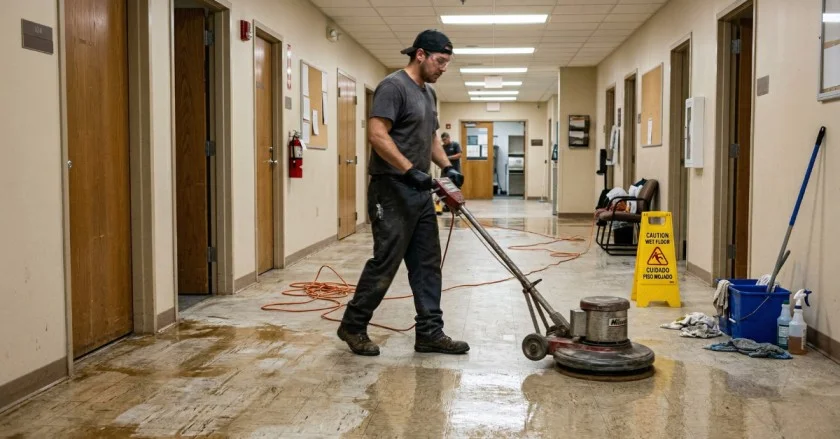
If you are wondering about strip and wax floor time, the honest answer is: most commercial floor stripping and waxing jobs take about 3 to 6 hours for a moderate-sized area, but larger, heavily worn, or high-traffic floors can take most of a night or even longer. That is because the job is not just “waxing.” It includes removing old finish, scrubbing, rinsing, drying, applying multiple coats, and allowing enough dry time between coats. Competitor sources commonly describe the full process as labor-intensive, with one source estimating a typical strip-and-finish job at around 4–5 hours, while another notes that 1,000 square feet may take roughly 120–150 minutes just for the strip-and-rewax portion, depending on method and conditions.
For beginners, that means this: a floor that looks simple can still take several hours because each phase matters. If the old finish is stubborn, if the floor needs extra scrubbing, or if more coats are needed for a high-shine result, the commercial floor cleaning time goes up fast.
The Short Answer: Typical Time Range
Here is a practical estimate for how long to wax floors after a full strip:
- Small area or light-duty job: about 2 to 4 hours
- Average commercial space: about 3 to 6 hours
- Large or high-traffic facility: 6 hours to overnight
- Complex buildings like schools, healthcare spaces, or phased projects: sometimes multiple shifts or multiple days depending on access, drying needs, and safety planning
A big reason for the wide range is that professionals often apply four coats of finish, and high-traffic spaces may need five or six coats. One competitor also notes that finish can dry in about 30 minutes per coat, which adds real time even when the crew works efficiently.
What Actually Happens During the Floor Waxing Process?
To understand the timing, it helps to understand the floor waxing process itself.
1. Area prep
Before anything starts, the space needs to be cleared, dust mopped, and protected. Furniture, signs, and traffic control all affect setup time. On commercial jobs, prep and cleanup can add meaningful labor beyond the stripping itself. One source discussing a 4,000-square-foot example says the total time increases once prep and cleanup are included.
2. Apply floor stripper
The stripper has to sit long enough to soften the old finish. Competitor guidance shows this dwell time alone can take 15 minutes to 1 hour, depending on buildup and product strength.
3. Scrub and remove old wax
This is where crews do the hard work: loosening old finish, embedded dirt, and grime. If the floor has not been maintained well, scrubbing may need to be repeated more than once. Some competitors note the scrub step may need to be repeated 1 to 3 times when the old finish is difficult to remove.
4. Rinse and dry completely
This step is often underestimated. Any leftover stripper or moisture can interfere with adhesion and ruin the final result. That is why professionals take time to neutralize, rinse, and let the floor dry fully before new finish goes down.
5. Apply new finish
Once the floor is clean and dry, new finish is applied in thin, even coats. Many contractors use four coats, while high-traffic areas may need five to six for extra protection and shine. Each coat needs drying time before the next goes on.
6. Final cure and reopening
Even when a floor is dry enough for light foot traffic, it may still need additional cure time before heavy traffic, rolling equipment, or furniture is allowed back on it. That is one reason many commercial jobs are scheduled overnight.
You also can read: What’s the Difference Between Cleaning and Janitorial Services?
What Affects Strip and Wax Floor Time?
Not every floor takes the same amount of time. Here are the biggest variables.
Floor size
This is the most obvious factor. A 1,000-square-foot job can be much faster than a full office building, school wing, or medical facility. One competitor specifically estimates 120 to 150 minutes for stripping and rewaxing 1,000 square feet, but that does not always include every real-world delay, such as moving obstacles or extra dry time.
Condition of the existing finish
If the old wax is peeling, yellowed, or full of embedded dirt, the crew may need more passes to remove it. Imperial Dade points out that visible contaminants trapped in the finish are one sign a full strip and wax is needed instead of a lighter scrub and recoat.
Number of coats needed
A lobby, school hallway, or other high-traffic zone usually needs more protection than a lightly used room. More coats mean better durability, but also more time.
Labor and equipment
Equipment quality changes the timeline a lot. One source cites ISSA work-rate examples showing a 4,000-square-foot stripping job may take about 5 hours, and around 7 hours total once prep and cleanup are included. The same article argues labor is usually the biggest cost in the job.
Maintenance history
If the floor has been regularly maintained with scrub-and-recoat service, a full strip and wax may be needed less often and may be easier when it does happen. Competitor content suggests interim maintenance can reduce the need for frequent full restoration.
Strip and Wax vs. Scrub and Recoat
This is one of the biggest points competitors mention, and it matters for timing.
A scrub and recoat only removes the top wear layer and adds new finish, so it usually takes less time and fewer resources. A full strip and wax removes all old finish and starts fresh, which takes longer but is necessary when the floor has deep wear, trapped dirt, or too little finish left. Imperial Dade recommends scrub and recoat as periodic maintenance in many cases, but says a full strip and wax is often the better choice when maintenance has been neglected for 6 to 12 months or when the finish is badly contaminated.
So if you are asking, “Why is this job taking so long?” the answer may be that your floor is beyond a quick refresh and needs full restoration.
How to Estimate Time More Accurately
If you want a more realistic estimate for your building, ask these questions:
- How many square feet need service?
- Is the floor lightly worn or heavily built up?
- How many coats of finish are planned?
- Does the area need furniture moved?
- Can the job be done after hours without interruptions?
- Is this a full strip and wax or just a scrub and recoat?
As a rule of thumb, the cleaner and better maintained the floor is, the faster the job will go. The more buildup, traffic, and detail work involved, the longer the project takes.
Final Thoughts
So, how many hours does it take to strip and wax a floor? For most commercial spaces, expect around 3 to 6 hours, with smaller jobs sometimes finishing faster and larger or more damaged floors requiring an overnight service window. The full answer depends on square footage, floor condition, number of finish coats, dry time, and whether the crew is doing a true full restoration or a lighter maintenance service.
If your floors are dull, scuffed, or no longer responding to regular cleaning, it may be time for professional help. Grand Slam Janitorial can help restore shine, improve appearance, and protect your commercial floors with expert stripping and waxing services.
