
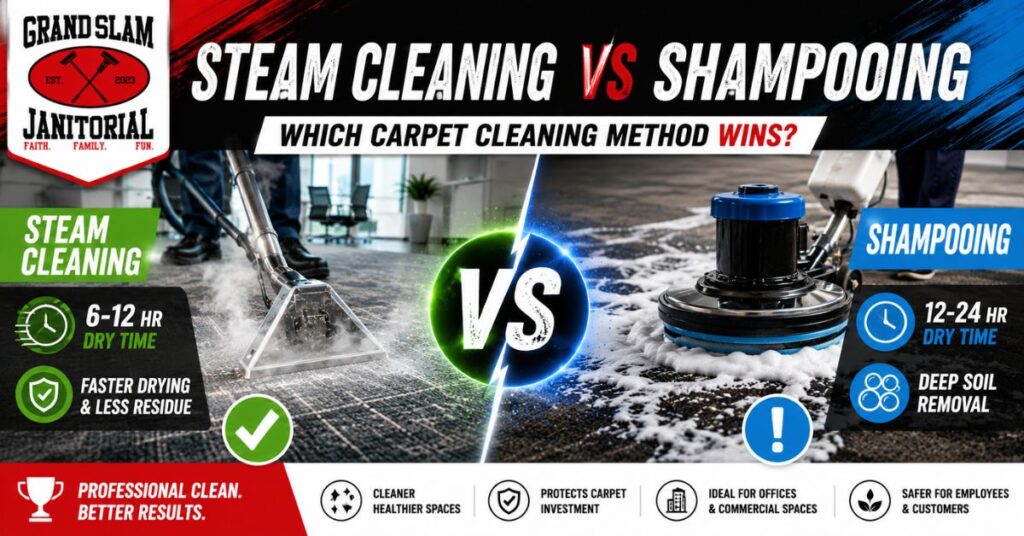
If you manage an office, retail space, or medical facility in Las Vegas, the honest answer is this: for most commercial carpet cleaning jobs today, hot water extraction (commonly called steam cleaning) has mostly replaced traditional rotary shampooing, because it dries faster, leaves less residue, and keeps a business running with less disruption.
Shampooing still has a place, especially for heavily soiled carpet or deep, set-in grease that can respond well to it, but it’s no longer the default most janitorial contractors reach for first when they’re working around business hours, foot traffic, and a lease that expects the lobby to look presentable Monday morning.
Below, we’ll walk through how each method actually works, where each one wins, what it costs in downtime (not just dollars), and the questions a facility manager should ask before signing off on either one.
How Carpet Shampooing Works
Carpet shampooing applies a foaming detergent to the carpet, then works it into the fibers using a rotary machine with rotating brushes. The agitation breaks the bond between dirt and the carpet fiber, and the foam is later extracted or vacuumed away once it dries.
This method has been around for decades and is still genuinely good at one thing: cutting through heavy, greasy, or deeply embedded soil that a gentler method might just smear around. Restaurant entryways, loading dock carpet, and high-traffic lobby mats sometimes need that extra mechanical scrubbing.
Where shampooing falls short in an office setting
- Drying time. Most commercial sources put shampoo drying time at 12–24 hours, sometimes longer in humid conditions, which is a problem if you need the space usable the next business day.
- Residue. Even with a rinse pass, foaming detergent is difficult to fully extract. What’s left behind can attract new dirt as it dries, meaning the carpet can look dirty again faster.
- Fiber wear. Aggressive brush agitation, repeated over months and years, can flatten the pile and dull the look of carpet tile faster than a gentler extraction method.
- Fading industry use. Several commercial cleaning operators note that rotary shampooing has been largely phased out of routine office maintenance in favor of hot water extraction or low-moisture encapsulation, and is now used more as a targeted, occasional treatment than a default monthly method.
In short, shampooing can deep-clean heavy soil, but the long dry time and residue make it a poor fit for routine office maintenance where you need the space back fast.
How Steam Cleaning (Hot Water Extraction) Works
Despite the name, commercial “steam cleaning” is technically hot water extraction. A machine injects heated water, sometimes with a light, low-residue cleaning agent, directly into the carpet fibers under pressure, then immediately extracts it back out along with the loosened soil.
There’s no scrubbing brush involved and very little detergent left behind, which is part of why this has become the more common choice for businesses that need carpet cleaned without shutting down the workspace for two days.
Where hot water extraction performs well
- Faster turnaround. Drying time generally falls in the 6–12 hour range with proper airflow, which is realistic to schedule overnight or over a weekend.
- Lower chemical load. Useful in medical offices or any workplace with staff sensitive to strong cleaning odors.
- Gentler on fibers over time. Less mechanical agitation means less wear on the carpet pile across repeated cleanings.
- Better for routine maintenance cycles. Most commercial cleaning programs use this as the standard quarterly or semi-annual deep clean, with shampooing reserved for specific heavy-soil problem areas.
Where it’s not automatically the better choice
- A very heavily soiled or greasy carpet may need a pre-treatment pass (sometimes including light agitation) before extraction will fully lift the soil. This can add time to the total job length.
- If too much water is used or extraction is rushed, moisture can sit in the carpet backing or sub-floor, which becomes a mold and mildew risk. This is an equipment and technique issue, not a flaw in the method itself.
In short, hot water extraction is the better fit for most recurring office carpet maintenance because of faster drying and lower residue, but it still depends on a technician doing the extraction pass properly.
Steam Cleaning vs. Shampooing: Side-by-Side for Commercial Carpet
Here’s how the two methods stack up specifically on the factors that matter to a facility manager, not a homeowner.
Factor | Carpet Shampooing | Hot Water Extraction (Steam) |
|---|---|---|
Typical dry time | 12–24+ hours | 6–12 hours |
Detergent residue | Harder to fully rinse out | Low to minimal |
Best for | Heavy, greasy, or ground-in soil | Routine maintenance, sensitive environments |
Fiber wears over time | More agitation, more wear | Gentler, less mechanical wear |
After-hours scheduling fit | Tighter, longer dry time eats into open hours | Easier fits an overnight or weekend window |
Common use in offices today | Occasionally, targeted heavy-soil areas | Standard recurring deep-clean method |
In short, if you only remember one row, it’s the drying time that usually decides whether a method works for an occupied business.
Why Business Downtime Should Drive Your Decision, Not Just Price
A lot of commercial cleaning comparisons online are written for homeowners deciding how to clean a living room rug. That’s a different decision from yours.
In an office, retail floor, or medical waiting room, the real cost of carpet cleaning isn’t just the invoice; it’s what happens if the carpet is still damp when the doors open, or if a strong detergent smell greets the first client of the day. A cleaning job that finishes technically “on time” but leaves carpet unusable until mid-morning can cost more in disruption than it saved in cleaning fees.
This is where scheduling and method choice need to work together:
- If your facility can only be cleaned overnight or over a weekend, hot water extraction’s shorter dry window is usually the safer bet.
- If a specific area (entryway, break room, loading zone) has heavy, set-in soil that routine extraction isn’t lifting, a targeted shampoo pass on just that area, not the whole floor, can solve it without extending dry time across the entire space.
- Ask any janitorial contractor how they plan to handle furniture, foot traffic barriers, and air circulation during drying; that operational detail affects your actual downtime more than the method name does.
In short, the method matters less than whether your cleaning plan accounts for when your business actually needs the floor back.
You also can read: What Is the 80/20 Rule in House Cleaning?
Does Your Carpet Type Change the Answer?
Yes, and this is one of the most overlooked steps before booking a commercial deep clean. Office carpet generally falls into a few categories, and they don’t all respond the same way to either method.
- Broadloom (wall-to-wall) carpet is common in private offices and conference rooms. Handles hot water extraction well in most cases.
- Carpet tile common in open-plan offices and corridors. Can have a moisture-sensitive adhesive backing, so the extraction technique and water volume matter more here.
- Glue-down carpet over-wetting carries a real risk of backing delamination, so a controlled, low-moisture approach is usually safer.
Before any one-off deep clean, it’s worth checking your carpet manufacturer’s care guidelines or warranty terms. Some commercial carpet warranties specify approved cleaning methods and minimum cleaning frequency; using the wrong method or skipping cleanings for too long can technically void coverage. A reputable commercial cleaning company should ask about this upfront rather than assuming one method fits every floor in the building.
In short: check your carpet type and warranty terms before the job, not after it’s a five-minute conversation that can prevent an expensive mistake.
What Does Commercial Carpet Cleaning Typically Cost?
Pricing for commercial carpet cleaning is generally quoted per square foot rather than as a flat homeowner-style rate, since office floor plans vary so widely in size and furniture density. Expect your quote to factor in:
- Total carpeted square footage and number of rooms
- How much furniture needs to be moved versus cleaned around
- Current soil level, a first-time deep clean on neglected carpet usually costs more than a maintenance clean on a schedule.
- Whether the job needs to happen after hours or on a weekend
A transparent commercial cleaning company should walk your space and give you a written proposal rather than a phone-quote guess, and should be upfront if shampooing one heavy-soil area would cost less than steam-cleaning the entire floor.
In short: the cheapest quote on paper isn’t always the cheapest outcome if it leads to longer downtime or a redo six weeks later.
Why a Recurring Cleaning Plan Usually Beats a One-Time Deep Clean
Whichever method you choose for a single deep clean, the bigger factor in how your office carpet looks and lasts is how often it’s maintained between deep cleans. A carpet that only gets attention once a year tends to need the more aggressive, slower-drying treatment every single time, because soil has had months to embed.
A facility on a regular vacuuming and spot-cleaning schedule, with a deep clean every quarter or two, generally needs less aggressive intervention at each visit, which usually means shorter dry times, lower cost per visit over a year, and less guesswork about which method is needed.
This is also where flexibility matters. A facility shouldn’t have to commit to a long-term contract just to get a sensible recurring schedule. A cleaning plan should be able to adjust if your foot traffic, season, or business hours change.
In short, the method debate matters less once you’re on a consistent maintenance schedule, because the carpet simply doesn’t get soiled enough to need the harshest option.
Practical Tips Before You Book a Commercial Carpet Cleaning
- Ask which method the contractor plans to use and why for your specific carpet type, not a generic answer.
- Confirm realistic dry time and whether the job can happen outside business hours.
- Check your carpet manufacturer’s warranty terms for approved cleaning methods before a major deep clean.
- Request a written proposal that separates square footage, furniture-moving, and soil-level pricing, not a single vague number.
- Ask how often the company recommends a deep clean for your traffic level, rather than accepting a one-size-fits-all schedule
FAQs
For most routine office maintenance, hot water extraction (steam cleaning) tends to work better because it dries faster and leaves less residue. Shampooing can still be the right call for specific, heavily soiled areas that need stronger mechanical agitation.
It depends on foot traffic, but many commercial facilities schedule a deep clean every 3–6 months, paired with regular vacuuming and spot treatment in between. High-traffic entryways may need more frequent attention than a private office.
Not necessarily, but the rotating brush agitation used in shampooing can be harder on certain carpet tile adhesives and pile types than a controlled hot water extraction pass. It's worth confirming the method against your specific tile manufacturer's guidelines first.
Yes, and for most offices, this is the more practical option. Scheduling cleaning overnight or over a weekend, combined with a faster-drying method like hot water extraction, minimizes disruption to staff and clients.
It's possible. Some commercial carpet manufacturers specify approved cleaning methods and minimum cleaning frequency as a condition of warranty coverage. Always check your documentation or ask your cleaning provider to confirm compatibility before a deep clean.
Yes. Grand Slam Janitorial serves businesses across Las Vegas, Nevada, with both hot water extraction and shampooing as part of its broader commercial cleaning and carpet shampooing services, and recommends the right method based on a free on-site walkthrough of your specific carpet and traffic patterns, not a generic, one-size-fits-all answer.
Choosing the Right Method for Your Facility
There’s no single “best” method that wins in every office, retail space, or medical facility. The right choice depends on your carpet type, how soiled it is, and how much downtime your business can realistically absorb. What’s consistent across most commercial settings, though, is that hot water extraction has become the more practical default for routine maintenance, while shampooing still earns its place for specific, heavily soiled problem areas.
If you’re trying to figure out which approach fits your Las Vegas facility, Grand Slam Janitorial offers a free on-site walkthrough and a detailed cleaning proposal within 24–48 business hours with transparent pricing, no long-term contract required, and a team that’s licensed, insured, and background-checked.
Call now or request a free quote to schedule a consultation and get a cleaning plan built around your actual carpet, traffic, and schedule.
