
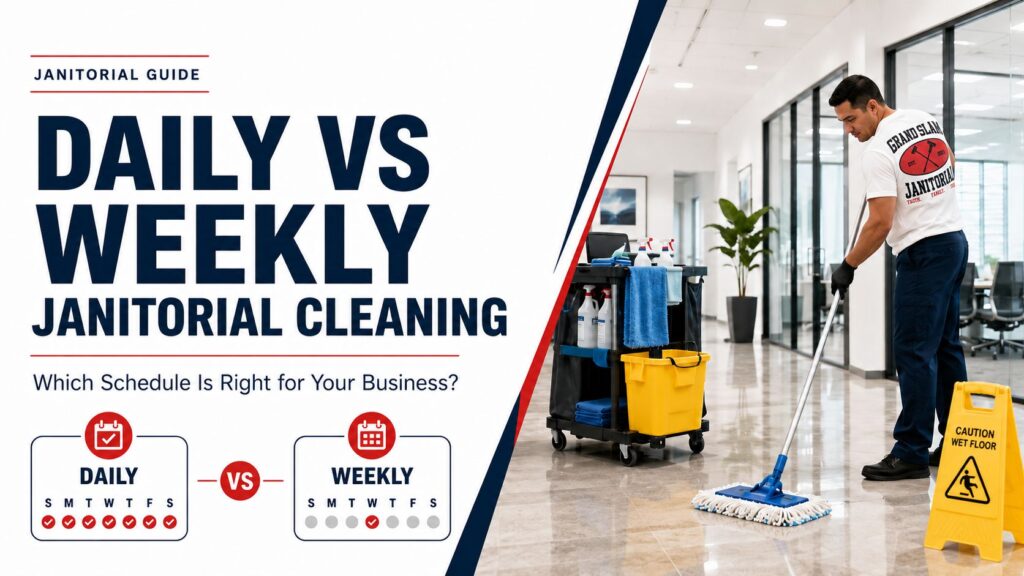
Choosing between daily vs weekly janitorial services depends on how your building is used. High-traffic, customer-facing, medical, retail, and multi-tenant spaces usually need daily or near-daily cleaning, while smaller, low-traffic offices may do well with weekly service plus a few targeted touch-ups. For many businesses, the right answer is not daily or weekly. It is a custom schedule that cleans the busiest areas more often and saves deeper tasks for once a week.
For businesses in Las Vegas, Nevada, and Flagstaff, Arizona, that decision can also depend on dust, foot traffic, weather, restroom use, employee count, and how often clients visit your space.
Grand Slam Janitorial helps businesses choose a schedule based on the actual facility, not a one-size-fits-all package.
What is the main difference between daily and weekly janitorial services?
The main difference is frequency and purpose. Daily office cleaning keeps visible mess, trash, restroom use, and high-touch areas under control every business day. Weekly office cleaning is usually more detailed per visit, but it allows dust, fingerprints, odors, and clutter to build up between cleanings.
Daily cleaning is more about maintenance. Weekly cleaning is more about resetting.
A daily visit may include:
- Trash removal
- Restroom cleaning
- Breakroom wipe-downs
- Entryway sweeping
- Spot mopping
- Touchpoint cleaning
- Light dusting
- Restocking paper products, if included in the plan
A weekly visit may include:
- More detailed dusting
- Fuller vacuuming
- Deeper restroom attention
- Floor care in lower-traffic areas
- Interior glass cleaning
- Breakroom appliance wipe-downs
- More time spent on corners, edges, and buildup
In short: daily service prevents problems from getting noticeable. Weekly service catches up on the mess after it has had time to collect.
Daily vs weekly janitorial services comparison table
Factor | Daily janitorial service | Weekly janitorial service |
Best for | Busy offices, medical offices, retail, customer-facing spaces, multi-tenant buildings | Small offices, low-traffic suites, back-office spaces |
Main purpose | Keep the space consistently clean | Reset the space once per week |
Restrooms | Cleaned often enough to control odor, trash, and supply issues | Maybe enough only for very low-use restrooms |
Breakrooms | Better for shared kitchens and employee food areas | Works if staff keep up with daily tidying |
Floor care | Good for entryways and high-traffic dust or debris | Better for deeper vacuuming and detail work |
Cost | Higher monthly cost due to more visits | Lower monthly cost, but may need add-ons |
Client impression | More consistent throughout the week | Depends on which day clients visit |
Risk | Paying for more service than a low-use office needs | Letting odors, dust, and mess build up between visits |
In short: choose daily if your space gets visibly used every day. Choose weekly if your space stays fairly clean between visits and does not create health, odor, or presentation issues.
When daily janitorial services make sense
Daily cleaning is usually the right fit when your business cannot afford for the workplace to look or feel neglected by midweek.
That does not mean every inch of the building needs deep cleaning every night. It means the high-use areas need steady attention.
Daily or near-daily janitorial services usually make sense for:
- Offices with frequent client visits
- Medical offices and health-related facilities
- Retail businesses
- Corporate offices with larger teams
- Multi-tenant commercial buildings
- Warehouses with office areas and heavy foot traffic
- Professional service firms where first impressions matter
- Businesses with shared restrooms and breakrooms
For example, a small accounting office with three employees may not need daily service. A busy law office with clients in and out all day probably does, at least in reception, restrooms, conference rooms, and entryways.
Daily service also helps in desert and mountain-region environments. In Las Vegas, dust and tracked-in debris can quickly show near entry doors. In Flagstaff, snow, mud, and seasonal moisture can make floors harder to maintain during certain months.
In short: daily cleaning is not about being fancy. It is about keeping up with real usage before small messes turn into complaints.
When are weekly janitorial services enough?
Weekly service can be a smart choice for businesses with low daily traffic, smaller teams, or private office spaces where customers rarely visit.
A weekly schedule may work well for:
- Small professional offices
- Appointment-only businesses
- Back-office operations
- Private suites
- Low-use administrative spaces
- Small warehouses with limited office activity
- Businesses where staff handle light tidying between visits
The key is honesty. If trash overflows by Wednesday, restrooms smell by Thursday, or the breakroom gets sticky after one day, weekly service is probably too light.
Weekly commercial janitorial cleaning works best when the space still looks acceptable six days after the last visit.
In short: weekly cleaning is enough when your building stays manageable between visits. It is not enough when employees or customers start noticing the gap.
The hybrid schedule: often the practical middle ground
A hybrid cleaning schedule means some areas are cleaned daily or multiple times per week, while deeper or lower-use areas are cleaned weekly.
This is often the most practical choice for businesses that want clean restrooms, fresh breakrooms, and presentable entryways without paying for full-building daily service.
A hybrid recurring cleaning services plan may look like this:
Daily or 3-5 times per week
- Restrooms
- Breakrooms
- Lobbies and entryways
- Trash removal
- High-touch surfaces
- Main walkways
- Reception areas
Weekly
- Private offices
- Detailed dusting
- Interior glass
- Lower-traffic floor areas
- Conference room detail work
- Baseboards and corners as needed
Monthly or periodic add-ons
- Floor buffing services
- floor strip and wax services
- Carpet shampooing
- Window cleaning up to 2 stories
- Commercial deep cleaning
- More detailed disinfection work
This structure gives facility managers better control over budget and cleanliness. You are not over-cleaning quiet areas, and you are not ignoring the spaces people use most.
In short: a hybrid schedule is often the right answer when daily full-service cleaning feels like too much, but weekly service is clearly not enough.
How to choose the right cleaning schedule for your business
The easiest way to choose is to look at how the building behaves during a normal workweek.
Use this simple decision guide.
Choose daily cleaning if:
- Restrooms are used heavily every day
- Trash fills up before the next visit
- Clients, tenants, or patients visit often
- The breakroom needs attention daily
- Floors show dust, mud, spills, or debris quickly
- Employees complain about cleanliness
- You manage a larger facility or multi-tenant property
- Your business needs a consistent presentation every day
Choose weekly cleaning if:
- You have a small team
- Customers rarely visit
- Restrooms stay clean between visits
- Staff keep desks and shared areas tidy
- The office does not collect much dust or debris
- Budget is a major concern
- You only need a weekly reset
Choose a hybrid plan if:
- Restrooms and breakrooms need frequent service
- Private offices do not need daily cleaning
- Entryways get dirtier faster than the rest of the building
- You want better cleanliness without unnecessary service hours
- Your busy season changes throughout the year
Expert tip: Walk your building on a Thursday afternoon. That is usually when a weak cleaning schedule starts showing itself. Check restrooms, entryways, breakrooms, trash cans, floors, and door handles. If those areas look rough before the week is over, your schedule needs adjusting.
In short: the right cleaning schedule should match your building on its busiest ordinary day, not its cleanest day.
Warning signs your current cleaning schedule is not working
Sometimes the issue is not the cleaning company. It is the schedule.
Weekly service may be too light if you notice:
- Restroom odors before the next cleaning
- Overflowing trash
- Dust on desks, vents, or ledges
- Sticky breakroom counters
- Dirty entry mats
- Fingerprints on doors and glass
- Employees bringing in their own wipes or sprays
- Clients notice the mess before the staff does
- Floors looking dull or gritty
- Recurring complaints from tenants or managers
Daily service may be more than you need if:
- The cleaner has very little to do on each visit
- Most areas remain untouched by staff or visitors
- Restrooms are rarely used
- Your space is appointment-only and low traffic
- A 2-3 day schedule would cover the same needs
This is where a walkthrough helps. A professional cleaner can identify which zones need high-frequency attention and which ones can be handled weekly.
In short: do not pay for a schedule based on habit. Pay for a schedule based on what your facility actually needs.
What tasks should be included in a recurring janitorial plan?
A good custom cleaning plan should list what gets cleaned, how often it gets cleaned, and which tasks are considered add-ons.
For most businesses, recurring commercial cleaning services may include:
- Trash removal
- Dusting
- Vacuuming
- Floor sweeping and mopping
- Restroom cleaning and sanitization
- Breakroom cleaning
- Desk and counter wipe-downs
- High-touch surface cleaning
- Lobby and reception cleaning
- Interior glass spot cleaning
- Supply restocking if included
- Periodic deep cleaning services
Specialty services may be scheduled separately, such as carpet shampooing, facility maintenance cleaning, floor strip and wax, floor buffing, or window cleaning.
This matters because “weekly cleaning” can mean very different things from one provider to another. One company may include restrooms, floors, trash, and breakrooms. Another may treat some of those as extras.
Before signing off on a schedule, ask for the scope in writing.
In short: frequency matters, but scope matters just as much. A clear checklist prevents confusion later.
Local cleaning schedule examples for Las Vegas and Flagstaff businesses
A business in Las Vegas may need more frequent entryway and dust control because dry conditions can make dirt show faster, especially in high-traffic offices or retail spaces.
A Flagstaff business may need more floor attention during wet, snowy, or muddy seasons. Entry mats, hard floors, and restroom floors may need more care during those months.
Here are practical examples:
Small office with 5-10 employees
A weekly cleaning may work if the office has limited visitors and employees handle light daily tidying. Restrooms and trash should be checked honestly before choosing this schedule.
Professional office with regular client meetings
A hybrid plan often works well. Restrooms, entryways, reception, and meeting rooms may need cleaning 3-5 times per week, while private offices can be cleaned weekly.
Medical or health-related office
Daily restroom cleaning and sanitization, high-touch cleaning, trash removal, and waiting area attention are usually more appropriate because the space has higher hygiene expectations.
Retail or customer-facing business
Daily attention to floors, glass, checkout areas, restrooms, and high-touch surfaces is often needed because customers notice mess quickly.
Warehouse with office space
The office may not need daily detail cleaning, but entry points, restrooms, breakrooms, and high-traffic paths may need a more frequent schedule.
For businesses comparing janitorial services Las Vegas or janitorial services Flagstaff AZ, the best schedule starts with a facility walkthrough, not a guess.
In short: local conditions, building use, and customer visibility should shape the schedule more than a generic package.
Why Grand Slam Janitorial starts with a walkthrough
Grand Slam Janitorial serves businesses in Las Vegas, Nevada, and Flagstaff, Arizona with regular, deep, and specialty cleaning options.
A walkthrough helps answer the questions that pricing sheets cannot:
- How many people use the space each day?
- Which areas get dirty first?
- Are restrooms shared by staff, customers, or tenants?
- Does the breakroom need daily attention?
- Are floors hard surface, carpet, tile, or mixed?
- Are there health-conscious cleaning needs?
- Does the business need after-hours cleaning?
- Are specialty services needed monthly or quarterly?
After the walkthrough, Grand Slam Janitorial can recommend office cleaning, high-touch surface sanitization, restroom care, floor maintenance, or deep cleaning based on the space.
The goal is simple: build a cleaning schedule that fits the business without locking it into unnecessary service.
FAQs
Most offices should be professionally cleaned at least once a week, but busy offices often need service 3-5 times per week or daily. The right answer depends on employee count, visitor traffic, restroom use, and how quickly the space becomes visibly dirty.
Weekly cleaning can be enough for a small, low-traffic business if restrooms, trash, floors, and breakrooms stay manageable between visits. If odors, dust, or overflowing trash show up midweek, weekly service is probably not enough.
Daily janitorial cleaning usually includes trash removal, restroom cleaning, breakroom wipe-downs, spot mopping, entryway cleaning, high-touch surface cleaning, and light dusting. The exact scope should be listed in the cleaning proposal.
A hybrid cleaning schedule combines frequent cleaning for high-use areas with weekly detail work for lower-use spaces. For example, restrooms and breakrooms may be cleaned daily, while private offices and detailed dusting are handled weekly.
Not always. A small office may only need weekly service if it has limited staff, few visitors, and light restroom use. However, small offices with daily clients, shared restrooms, or messy breakrooms may still need more frequent cleaning.
Start by checking foot traffic, restroom use, customer visibility, employee count, floor condition, and complaints. Then decide which areas need daily attention and which areas can be cleaned weekly.
Yes. A cleaning schedule should be flexible. Many businesses start weekly, then move to a hybrid or daily plan once they see how the space holds up between visits.
Choose the schedule your building actually needs
The right choice between daily vs weekly janitorial services comes down to usage, not guesswork. Daily cleaning is better for busy, customer-facing, health-conscious, or high-traffic facilities. Weekly cleaning can work well for small, low-use offices. A hybrid plan often gives businesses the cleanest balance between appearance, hygiene, and budget.
If your restrooms, breakrooms, floors, or entryways look rough before the next cleaning visit, your current schedule may not be doing enough.
Grand Slam Janitorial can help you choose a realistic schedule for your business in Las Vegas, NV, or Flagstaff, AZ.
