
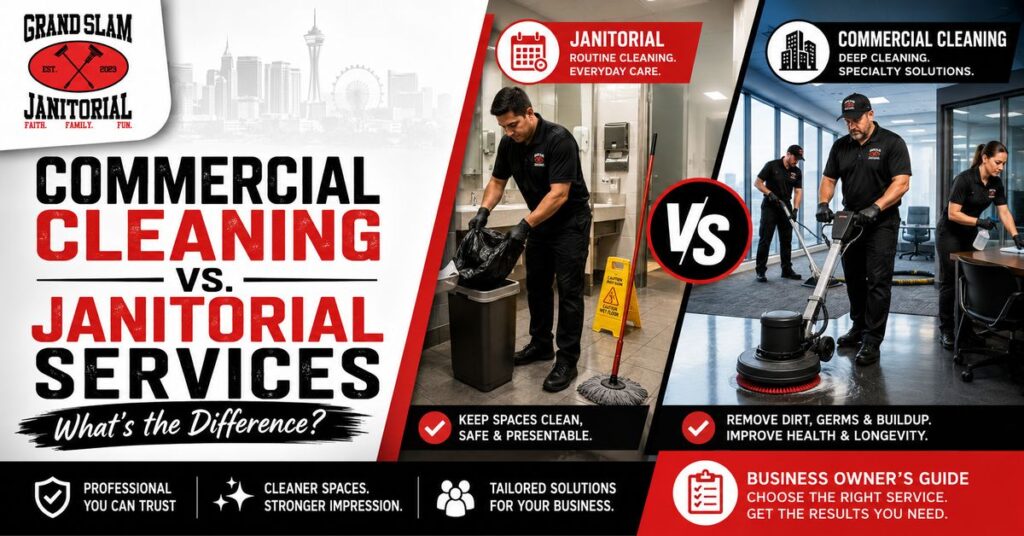
If you’ve started looking for professional cleaning help for your facility and found yourself confused about whether you need “commercial cleaning” or “janitorial services,” you’re not alone. The two terms get used all the time interchangeably, even by companies that provide them. They’re not the same thing, and understanding the difference can save you money and help you get the right coverage for your space.
Commercial cleaning vs. janitorial services comes down to scope and frequency. Janitorial services cover the routine, recurring maintenance that keeps your facility functional day to day, trash removal, restroom cleaning, floor mopping, and surface wiping. Commercial cleaning is the broader category that includes all of that, plus periodic specialty work like floor strip and wax, carpet shampooing, window cleaning, and professional disinfection services.
Most businesses need both. The question is figuring out the right combination for your specific facility.
First, Let’s Clear Up the Terminology
The cleaning industry isn’t great at standardizing its own language. You’ll see the same company use “commercial cleaning” to mean everything they do and “janitorial services” to mean the routine subset of their work. Here’s a cleaner way to think about it.
What Janitorial Services Actually Cover
Janitorial services are the baseline of the recurring cleaning tasks that keep your facility in working order week after week. Think of this as the maintenance layer: if it’s not done consistently, the facility starts to look and feel neglected pretty quickly.
Standard janitorial tasks include:
- Emptying trash and replacing liners in all areas
- Vacuuming carpeted floors and entry mats
- Sweeping and mopping hard surface floors
- Cleaning and sanitizing restrooms, toilets, sinks, mirrors, floors, and restocking supplies
- Wiping down desks, counters, and shared surfaces
- Cleaning breakroom counters, sink, microwave exteriors, and tables
- Spot-cleaning glass doors and interior windows
This is the day-to-day work that most people picture when they hear “cleaning crew.” It’s the foundation of any facility maintenance plan.
What Commercial Cleaning Covers
“Commercial cleaning” is the broader umbrella. It includes everything janitorial services cover, plus specialty and deep cleaning services that are done periodically rather than nightly or weekly.
Examples of commercial cleaning work that go beyond basic janitorial:
- Floor buffing and burnishing, restoring shine to hard floors between strip-and-wax jobs
- Floor strip and wax, removing old finish and applying a fresh protective coat
- Carpet shampooing and hot water extraction
- Window cleaning up to two stories
- High-touch surface disinfection programs
- COVID, cold, and flu disinfection cleaning
- Post-event or periodic facility deep cleaning
- Office disinfection services
When a commercial cleaning company says they offer comprehensive service, they usually mean they can handle both your routine janitorial coverage and your periodic specialty needs under a single relationship.
In short, Janitorial services are a component of commercial cleaning, not a competitor to it. You’re not choosing one or the other; you’re figuring out how much of each your facility needs.
Commercial Cleaning vs. Janitorial Services: Key Differences at a Glance
Feature | Janitorial Services | Commercial Cleaning (Specialty) |
Frequency | Daily, nightly, or several times per week | Monthly, quarterly, or as needed |
Scope | Routine upkeep and maintenance | Specialty, restorative, or intensive work |
Examples | Trash, mopping, restrooms, breakroom, surfaces | Floor waxing, carpet shampooing, disinfection, and window cleaning |
Scheduling | Recurring on the same schedule each week | Flexible schedule as needed or on a cycle |
Best For | Ongoing facility cleanliness day to day | Restoring surfaces, addressing health concerns |
Contract Type | Recurring service agreement | Can be one-time or bundled with routine service |
A commercial cleaning company that can handle both sides of the table is worth a lot. It simplifies vendor management and usually results in more consistent output.
In short: These aren’t competing services. They work together. Your recurring janitorial program handles maintenance; specialty cleaning handles the things maintenance can’t.
So Which One Does Your Business Actually Need?
Almost every commercial facility needs some version of both. But the balance shifts depending on how your space is used, how much foot traffic it sees, and what type of business you run.
Signs You Need a Recurring Janitorial Program
If most of these apply to your facility, a regular janitorial service agreement is worth the investment:
- You have 10 or more employees using the space daily
- Customers, clients, or visitors come through your facility regularly
- Your restrooms are used by multiple people throughout the day
- Trash accumulates across several departments or common areas
- Your breakroom gets used for daily meals and prep
A consistent janitorial program also has a meaningful impact on workplace health. High-touch surfaces, door handles, light switches, shared equipment, and breakroom counters are well-documented transmission points for common illnesses. Regular sanitization of these areas as part of a structured program reduces sick days over time, which has real dollar value for any business.
Signs You Also Need Periodic Commercial Deep Cleaning
Even with reliable weekly janitorial coverage, certain things need more intensive attention over time:
- Carpets that haven’t been professionally shampooed in six months or more
- Hard floors that have lost their finish or are becoming difficult to clean properly
- Any time a contagious illness has circulated through your team
- A breakroom or restroom that needs a thorough reset, not just routine cleaning
- Windows that haven’t been professionally cleaned in over a year
- A facility preparing for a major event, inspection, or new tenant move-in
These aren’t signs of a poorly run facility; they’re just the normal cycle of how commercial spaces age and recover.
The Services That Fall Between Routine and Deep Cleaning
There’s a middle category that often catches business owners off guard: services that aren’t done daily, but that aren’t rare one-time events either.
Floor buffing is a good example. Your hard floors might get mopped weekly as part of your janitorial program. But buffing using a high-speed machine to restore the floor’s shine and surface integrity typically gets done monthly or bi-monthly, depending on traffic. It’s more intensive than mopping but less involved than a full strip and wax job.
High-touch surface disinfection works similarly. Some facilities add this as a weekly or bi-weekly service layered on top of regular janitorial work, especially in medical offices, multi-tenant buildings, or spaces with consistent employee movement in and out.
A well-structured commercial cleaning plan accounts for all three layers: routine maintenance, periodic specialty services, and the occasional deep clean or restoration project.
In short: When building a cleaning plan, think in frequency tiers: daily/weekly tasks, monthly tasks, and quarterly or as-needed services. A good cleaning company will help you map this out based on your actual facility, not a generic checklist.
You also can read: What Is the 80/20 Rule in House Cleaning?
Why Facility Cleanliness Matters Differently in Las Vegas
Las Vegas isn’t a typical operating environment for a business, and that extends to cleaning needs.
The desert climate means dust accumulation is faster than in most cities. Particulate matter settles on surfaces, gets tracked in on shoes, and recirculates through HVAC systems that run nearly year-round to manage the heat. Facilities that don’t have a consistent floor sweeping, mopping, and surface cleaning program end up with a layer of fine dust that makes everything look older and less professional than it actually is.
The culture of the city matters too. Las Vegas has one of the highest concentrations of hospitality and professional service businesses in the country. Clients, vendors, and business partners who walk into your office carry implicit expectations about presentation: a clean, well-maintained facility communicates something about how you run your business, and that expectation is especially sharp here.
For medical offices and professional service firms in particular, cleanliness is part of the product. A patient walking into a medical office or a client walking into a law firm is making a judgment about your standards within about 30 seconds of entering. That judgment starts with how the space looks, smells, and feels.
Grand Slam Janitorial serves businesses across Las Vegas, Nevada, with cleaning programs built around actual facility needs, not package tiers that make you pay for things you don’t use.
What a Good Commercial Cleaning Proposal Process Looks Like
Before signing anything, a professional cleaning company should follow a clear process. Here’s what that should look like and why each step matters for getting what you actually need.
Step 1: On-site walkthrough
A quote done over the phone without seeing the space is almost always inaccurate, either too high because the estimator built in guesswork, or too low because they missed the scope. Any company you’re serious about should want to walk your facility before putting a number on paper.
Step 2: Custom-written proposal
After the walkthrough, you should receive a detailed cleaning proposal that spells out exactly what’s included, at what frequency, and at what price. Vague proposals lead to disputes. You want specifics. A good proposal typically arrives within 24 to 48 business hours of the walkthrough.
Step 3: Transparent pricing
There shouldn’t be a gap between what was quoted and what you’re billed. Ask upfront about anything that might be treated as an extra specialty service, supply restocking, and after-hours access fees so there are no surprises once service starts.
Step 4: Flexibility without pressure
Your cleaning needs will change over time. A cleaning partner that adjusts with your facility is more valuable than one that requires renegotiating from scratch each time. A company confident in its work doesn’t need to lock you into a long-term contract before you’ve had a chance to see what they can do.
Red Flags to Watch for When Evaluating Cleaning Companies
Not every company that offers commercial cleaning delivers the same standard of work. A few things worth watching for:
- Significantly lower bids without explanation. Undercutting competitors by a wide margin usually means something is being cut: cleaning product quality, time on site, staffing ratios, or insurance coverage.
- No background checks on cleaning staff. Your cleaning crew has after-hours access to your facility. Background-checked and vetted employees are a baseline, not a premium feature.
- Can’t produce proof of insurance. Ask for a certificate of liability insurance before agreeing to anything. This protects you if something is damaged or an incident occurs on your property.
- Vague scope of work in the proposal. If you can’t tell exactly what gets cleaned, how often, and by what method, you don’t have a real agreement.
- High-pressure contract tactics: A push to commit to long-term contracts before you’ve experienced the service is a yellow flag. Quality companies let their work speak first.
FAQs
Janitorial services refer to routine, recurring maintenance tasks, trash removal, restroom cleaning, floor mopping, and surface wipe-downs. Commercial cleaning is the broader category that includes janitorial work plus specialty services like floor waxing, carpet shampooing, and professional disinfection. Most facilities need both.
It depends on the space and team size. Businesses with 10 or more employees, customer-facing areas, or shared restrooms almost always benefit from at least weekly professional janitorial service. For many small offices, bi-weekly professional cleaning is enough to maintain standards without a large ongoing expense.
For most commercial spaces with moderate daily foot traffic, professional carpet shampooing every 6 to 12 months is a reasonable baseline. High-traffic areas or facilities with many client visits may benefit from more frequent cleanings. Regular vacuuming between professional cleans extends carpet life and keeps visible dirt from building up.
A standard recurring program usually covers trash removal, floor sweeping and mopping, restroom cleaning and sanitization, breakroom cleaning, and surface wiping in offices and common areas. Most programs can be customized to add high-touch surface disinfection, floor buffing, or window cleaning, depending on the facility's needs.
For most businesses, outsourcing to a professional commercial cleaning company is more cost-effective than bringing on dedicated in-house staff. You avoid the overhead costs of employment taxes, benefits, equipment maintenance, cleaning supplies, and management time. A professional service also carries liability insurance, which shifts certain risk off your plate.
Ask whether they conduct an on-site walkthrough before quoting, whether their staff is background-checked and vetted, whether they carry full liability insurance, what their written proposal process looks like, and whether they require long-term contracts. Clear answers to all of these are a good indicator of how the working relationship will go.
Yes, and ideally, they should. Working with a single provider for both your recurring janitorial program and your periodic specialty cleaning (floors, carpets, disinfection) is simpler to manage and typically produces more consistent results than splitting the work across multiple vendors.
Ready to Stop Guessing and Just Get a Plan?
The difference between commercial cleaning and janitorial services isn’t as complicated as it can seem. Janitorial services handle the day-to-day maintenance that keeps your facility functional and presentable. Commercial cleaning in its full scope covers everything from that routine work to the periodic specialty services that restore and protect your facility over time.
Most Las Vegas businesses benefit from a customized combination of both. The right mix depends on your facility size, how it’s used, and what your actual priorities are, not a generic package built around someone else’s needs.
Knowing the difference is just the first step. Having a reliable team execute it consistently is what actually moves the needle for your business.
Detailed cleaning proposal delivered within 24–48 business hours of your walkthrough. No hidden fees. No long-term contract required.
Call now, request a free quote, or schedule your on-site walkthrough at grandslamjanitorial.com
