
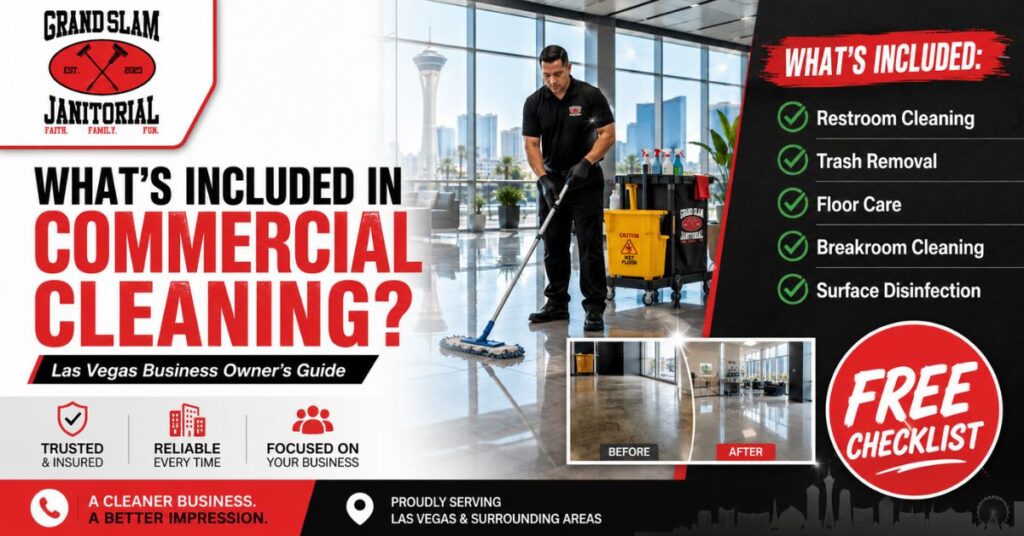
A standard commercial cleaning services plan typically covers restroom sanitization, trash removal, floor sweeping and mopping, surface dusting, and breakroom cleaning on a recurring schedule. Specialty work like carpet shampooing, floor stripping and waxing, or window cleaning above the ground floor is usually billed separately as an add-on, not bundled into the base price.
If you’ve ever stared at a cleaning quote and wondered why one company’s price is half of another’s, the answer is almost always in that second sentence. Two providers can call their service “full commercial cleaning” and mean completely different things.
What Does “Commercial Cleaning Services” Actually Mean?
Commercial cleaning is a broad umbrella term for professional cleaning performed in business settings rather than homes. It covers everything from a quick nightly office wipe-down to a full warehouse deep clean.
The confusion usually starts because “commercial cleaning” and “janitorial services” get used interchangeably, even though they describe slightly different scopes of work.
Janitorial Services vs. Commercial Cleaning: What’s the Real Difference?
Janitorial services generally refer to routine, recurring upkeep of the tasks that need to happen every day or every week to keep a space functional: restrooms, trash, floors, and breakrooms.
Commercial cleaning is often used as the broader category that includes janitorial work plus periodic deeper tasks, deep cleans, post-event cleanup, and specialty floor or carpet care.
In practice, most companies use the two terms loosely, so the label on a quote matters less than the itemized list underneath it. That’s the part worth reading closely.
In short: “Janitorial” usually means daily/weekly upkeep; “commercial cleaning” is the broader umbrella that can include deeper, less frequent work too. The terms overlap enough that you should judge a provider by their scope list, not their label.
The Core Tasks Included in Standard Commercial Cleaning
Most recurring commercial cleaning plans, regardless of provider, build around the same foundation. Here’s what that foundation typically includes:
Restroom Cleaning & Sanitization
- Cleaning and disinfecting toilets, sinks, and mirrors
- Restocking soap, paper towels, and toilet paper
- Sanitizing high-touch points like faucet handles and stall doors
- Mopping restroom floors and emptying restroom trash
This is the single most-checked item by facility managers during walkthroughs, and for good reason, restroom condition is often the first thing a visitor judges a business by.
Trash Removal & Recycling
- Emptying interior trash and recycling bins
- Replacing liners
- Transporting waste to designated outdoor collection areas
Floor Sweeping, Mopping & Vacuuming
- Sweeping and mopping hard floors
- Vacuuming carpeted areas
- Spot-cleaning visible debris near entryways
Note that this covers routine floor maintenance only. Heavier floor work, stripping, waxing, buffing, or deep carpet extraction is almost always a separate line item, which we’ll get to below.
Breakroom & Kitchen Cleaning
- Wiping countertops, tables, and sinks
- Cleaning the exterior of appliances like microwaves and refrigerators
- Emptying breakroom trash
Surface Dusting & High-Touch Disinfection
- Dusting desks, shelves, and accessible surfaces
- Disinfecting doorknobs, light switches, and shared equipment
In short, A standard plan is built around restrooms, trash, floors, breakrooms, and surface dusting/disinfection, the recurring tasks that keep a building functional day to day.
What’s Usually NOT Included (And Costs Extra)
This is the section most competitor checklists skip, and it’s the one that actually prevents billing surprises. Here’s a side-by-side look at what’s typically bundled into a base plan versus what gets quoted separately:
Usually Included in a Standard Plan | Usually Billed as an Add-On |
Restroom cleaning & sanitization | Floor strip, wax, and recoat |
Trash and recycling removal | Carpet shampooing / deep extraction |
Breakroom and kitchen wipe-down | Window cleaning above the ground floor |
Surface dusting and disinfecting | Post-construction or post-event cleanup |
Floor sweeping, mopping, vacuuming | High-touch surface disinfection (illness response) |
Trash liner replacement | Upholstery cleaning |
Glass spot-cleaning at entry doors | Specialty floor care (tile & grout, hard floor buffing) |
None of this means that add-on services are a bad deal; they’re often necessary. A medical office may need high-touch disinfection weekly, while a quiet professional services firm may only need it seasonally. The point is to know which column you’re paying for before the invoice arrives, not after.
In short: If a quote doesn’t separate routine upkeep from specialty work, ask for an itemized version. A vague “full-service” line is the most common source of billing disputes between businesses and cleaning vendors.
You also can read: What Is the 80/20 Rule in House Cleaning?
How Often Should Commercial Cleaning Happen?
There’s no single right frequency; it depends on foot traffic, facility type, and what your industry expects. Forcing every space into the same nightly schedule wastes money on low-traffic areas and underserves high-traffic ones.
A General Starting Point by Facility Type
- Medical and dental offices: Daily cleaning with disinfection focus, given health and compliance expectations
- High-traffic offices and retail: Nightly or 5x/week, prioritizing restrooms, floors, and entry areas
- Smaller professional offices: 2-3x/week is often sufficient for day-to-day upkeep
- Warehouses and industrial facilities: Frequency tied to production schedule rather than a fixed calendar, with periodic deep cleans
These are starting points, not rules. The honest answer is that the right frequency is whatever keeps the space consistently presentable between visits, and that’s worth discussing directly with a provider during a walkthrough rather than guessing from a generic list.
In short: Match cleaning frequency to actual usage, not habit. A facility manager who increases frequency in lobbies and restrooms while leaving rarely-used storage areas on a lighter schedule usually gets more value than one paying for uniform nightly service everywhere.
What Should a Commercial Cleaning Quote Actually Include?
A trustworthy quote should answer these questions without you having to ask:
- What specific tasks are performed at each visit? (Not “full cleaning,” an actual list.)
- How often does each task happen? Some tasks (restrooms, trash) may be nightly; others (window cleaning, floor waxing) may be monthly or quarterly.
- What supplies are included? Are paper products and soap restocked, or billed separately?
- Is there a written cleaning checklist the crew follows, and can you request a copy?
- What’s the process if something gets missed? Is there a re-clean policy?
- Are the staff background-checked, trained, and insured?
A provider that hesitates to put these details in writing, or that gives vague answers about scope, is worth a second look before signing anything long-term.
In short: The strongest signal of a reliable provider isn’t price, it’s whether they’ll hand you a written, itemized scope of work before you commit. If they won’t put it on paper, don’t assume it’ll show up in practice.
Cleaning Considerations Specific to Las Vegas Businesses
Climate and business patterns shape cleaning needs more than most owners expect, and Las Vegas has a few characteristics worth planning around:
Dust and Sand Infiltration
The desert environment means fine dust and sand work their way into buildings through doors, HVAC intake, and parking-lot foot traffic at a higher rate than in more humid climates. Entryway mats, vent-area dusting, and slightly more frequent floor attention near exterior doors tend to pay off here.
Dry Air and Flooring Wear
Low humidity can accelerate wear on certain hard flooring finishes and make static-prone dust more noticeable on dark surfaces. Facilities with hard floors may benefit from periodic buffing or recoating on a shorter cycle than the same flooring would need in a wetter climate.
Round-the-Clock Business Cycles
With hospitality, retail, and service businesses often operating extended or 24-hour schedules, cleaning windows sometimes needs to work around active occupancy rather than a simple after-hours slot. A provider familiar with the local business rhythm can usually schedule around this more smoothly than one applying a one-size-fits-all overnight model.
In short, None of this means Las Vegas businesses need a fundamentally different service; it means frequency and entryway/floor-care details are worth tailoring to the climate rather than copying a generic national checklist.
Recurring Cleaning vs. One-Time Deep Cleaning: Which Do You Need?
These solve different problems, and confusing them is a common source of disappointment.
- Recurring cleaning programs maintain a baseline of cleanliness between visits. They’re built for prevention, not for fixing a space that’s fallen behind.
- Deep cleaning services address buildup that routine cleaning doesn’t reach, such as baseboards, behind furniture, grout lines, vents, and are typically done quarterly, after move-ins, or before/after major events.
A facility that hasn’t had professional cleaning in a while usually needs a deep clean first, then a recurring program to maintain the result. Starting recurring service on a neglected space without a deep clean first often leads to the unfair impression that the new cleaning company isn’t doing a good job, when really the baseline was never reset.
In short: If it’s been months since your last professional clean, ask for a deep clean before starting a recurring schedule. It sets a fair baseline for what “maintained” should look like going forward.
When a Recurring Commercial Cleaning Contract Might Not Be the Right Fit
In the interest of giving genuinely useful advice rather than a sales pitch, recurring commercial cleaning isn’t always the best fit for every situation:
- Very small offices with light foot traffic (under 5-10 people) sometimes get more value from a lighter, less frequent service or even a part-time in-house solution.
- Businesses with highly irregular hours or frequent location changes may find a flexible, on-call arrangement more practical than a fixed recurring contract.
- A space that just needs a single deep clean after a renovation, move, or event doesn’t need an ongoing contract at all.
A reasonable provider should be able to tell you honestly when a smaller or one-time service makes more sense than locking into a larger recurring plan, rather than pushing the biggest package available.
FAQs
A standard plan typically includes restroom sanitization, trash removal, floor sweeping and mopping, surface dusting, and breakroom cleaning, performed on a recurring schedule. Specialty services like carpet shampooing, window cleaning, and floor waxing are usually quoted separately.
Usually not beyond simple glass spot-cleaning at entry doors. Full interior or exterior window cleaning, especially above the ground floor, is typically billed as a specialty add-on rather than bundled into a base recurring plan.
It depends on facility type and traffic. Medical offices and high-traffic retail often need daily or near-daily service, while smaller professional offices may only need two to three visits a week. The right frequency is the one that keeps the space consistently presentable between cleanings.
Janitorial services usually refer to routine, recurring upkeep like restrooms, trash, and floors. Commercial cleaning is often the broader umbrella term that includes janitorial tasks plus periodic deeper work. In practice, the terms overlap enough that the itemized scope matters more than the label.
This varies by provider. Some include restocking of paper products, soap, and trash liners in the base price; others bill supplies separately. This should always be clarified in writing before signing a contract.
Ask for an itemized task list, the frequency of each task, what's included versus billed separately, whether staff are background-checked and insured, and what happens if a task gets missed. A provider willing to put these answers in writing is a good sign.
If it's been several months since your last professional cleaning, yes, a deep clean resets the baseline so the recurring service has a fair, maintained starting point rather than trying to catch up on built-up grime during normal visits.
Understanding what’s included in commercial cleaning services comes down to one habit: read the itemized scope, not the marketing label. “Full-service” and “comprehensive” mean nothing on their own; the task list and frequency underneath those words are what determine whether your facility actually looks the way you expect it to.
Grand Slam Janitorial puts that scope in writing before any contract is signed. Every commercial cleaning plan starts with a free on-site walkthrough, so the proposal reflects your actual facility, not a generic template. Whether you need a recurring program for an office, restroom, and breakroom upkeep for a retail space, or a one-time deep clean before a big event, the goal is a detailed, transparent proposal you can review within 24-48 business hours with no long-term contract required to get started.
If you’re comparing quotes or just trying to figure out whether your current cleaning service is actually covering what it should, schedule a free walkthrough with Grand Slam Janitorial and get a clear, itemized proposal for your Las Vegas facility, no guesswork, no hidden line items.
