
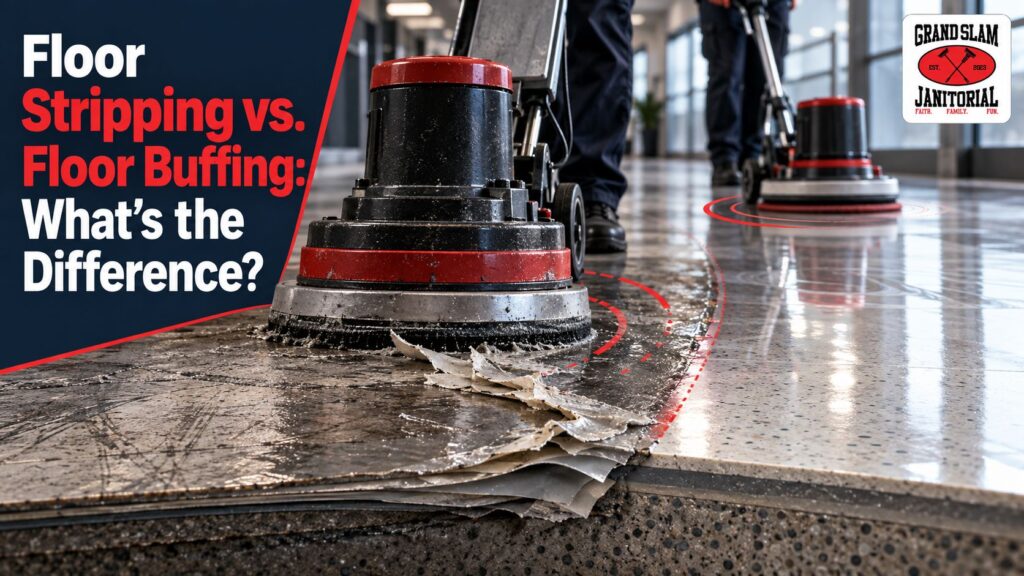
The main difference between floor stripping vs floor buffing is how much of the existing finish is removed. Stripping removes worn finish and buildup so new finish can be applied, while buffing works on the finish already in place to reduce minor marks and restore gloss.
If the finish is intact but dull, buffing may be enough. If it is peeling, yellowing, uneven, heavily scratched, or contaminated with embedded dirt, the floor may need stripping and refinishing.
In short: Buffing maintains a serviceable finish. Stripping replaces a finish that can no longer be maintained effectively.
What does floor stripping do?
Commercial floor stripping removes old layers of floor finish from a compatible hard-surface floor. A stripping solution softens the finish, and specialized equipment helps lift the dissolved coating and accumulated soil from the surface.
The basic process generally includes:
- Closing and preparing the work area
- Removing loose dirt and debris
- Applying the appropriate stripping solution
- Allowing the product to work according to its instructions
- Agitating the finish with a floor machine and suitable pad
- Recovering the dissolved finish
- Rinsing or neutralizing the floor as required
- Allowing the surface to dry
- Inspecting it before applying new finish
The purpose of floor finish removal is to create a clean, stable surface for new coats. Applying new finish over dirt, peeling material, or chemical residue can produce an uneven result.
People commonly call the protective coating “wax,” although many commercial systems use polymer-based floor finish. This is why contractors often use the term strip and wax services even when the applied product is technically a commercial finish.
In short: Stripping is a reset. It removes the existing finish so the protective coating can be rebuilt.
What does floor buffing do?
Commercial floor buffing is a maintenance process performed on an existing finish. A floor machine and compatible pad work across the surface to improve gloss and reduce the appearance of light scuffs and minor wear.
Unlike stripping, buffing does not intentionally remove every layer of finish. It works only when enough stable, compatible finish remains on the floor.
Floor buffing services are often useful for:
- Dull traffic lanes
- Light surface scuffs
- Minor variations in gloss
- Lobbies or hallways that need a cleaner appearance
- Finished floors that are still in sound condition
- Maintenance between more extensive services
Buffing cannot correct peeling finish, severe discoloration, deep scratches, or dirt trapped beneath several layers of coating. It may temporarily make an uneven floor shinier without resolving the underlying problem.
Does buffing remove floor wax? Buffing may affect a very small amount of the surface layer, depending on the pad, equipment, product, and method. Its purpose, however, is to maintain or polish the existing finish, not remove it completely.
In short: Buffing improves a finish that is still usable. It does not replace a failed finish or repair damage in the flooring material.
Floor stripping vs floor buffing at a glance
Factor | Floor stripping | Floor buffing |
Main purpose | Remove worn finish and prepare for refinishing | Maintain and restore the appearance of existing finish |
Amount of finish removed | Most or all removable finish | Minimal surface-level effect |
Good for | Peeling, yellowing, heavy buildup and widespread finish failure | Dullness, light scuffs and minor traffic wear |
Follow-up work | Usually requires new finish | May be completed as routine maintenance |
Labor required | More intensive | Less intensive |
Facility disruption | Greater because stripping, rinsing, drying, and refinishing take time | Usually easier to schedule around operations |
Corrects deep flooring damage | No | No |
Typical role | Periodic restoration | Ongoing maintenance |
Flooring compatibility | Must be confirmed before service | Must also be confirmed before service |
The last two rows matter. Neither process repairs cracked tile, damaged seams, deep gouges, loose flooring, or damage within the material itself.
How do you know which service your floor needs?
The decision should be based on the condition of the finish, not shine alone.
Signs buffing may be sufficient
Consider buffing when:
- The floor finish is intact
- The surface is dull but evenly coated
- Scuffs are light and mostly limited to traffic lanes
- Routine cleaning still removes soil
- There is no widespread peeling or flaking
- The surface responds to a small test area
For example, a finished office lobby may become dull near the entrance while the rest of the coating remains stable. Buffing the traffic lane may improve its appearance without requiring a complete restoration.
Signs stripping may be necessary.
Consider floor refinishing when:
- The finish is yellowing or discolored
- Old coating has accumulated unevenly
- Dirt appears trapped under the finish
- The surface has widespread deep scuffs
- Finish is flaking, peeling, or separating
- Previous finish applications produced streaks or uneven layers
- Cleaning and buffing no longer produce a consistent result
Competitor and equipment guidance consistently distinguishes stripping as removal of old finish and buffing as lighter maintenance of the current surface.
Signs the problem is not the finish
A cleaning contractor should not treat every floor problem as a stripping problem.
Cracked tiles, open seams, moisture damage, deep cuts, loose sections, or wear through the flooring pattern may require repair or replacement. Stripping the finish will not correct structural or material damage.
How do I know if my floors need stripping? Start with an inspection and a test area. If cleaning and buffing cannot produce an even result because the finish itself is failing, stripping may be the appropriate next step.
In short: Buff dull but stable finish. Strip finish that is worn, contaminated, uneven, or separating. Repair damaged flooring before treating its finish.
Can every commercial floor be stripped or buffed?
No. Can all floors be stripped and waxed? Absolutely not.
The flooring material, protective coating, installation method, product warranty, and manufacturer’s maintenance instructions must be identified before work begins.
Traditional VCT floor care often includes polish application, routine cleaning, buffing, and periodic stripping. However, some newer commercial vinyl products use factory-applied, no-polish coatings that do not require traditional stripping or refinishing.
Special precautions may also apply to:
- Luxury vinyl tile
- Sheet vinyl
- Linoleum
- Rubber flooring
- Sealed concrete
- Terrazzo
- Natural stone
- Wood flooring
- Slip-resistant flooring
- Static-control flooring
A method that works on finished VCT may damage another surface or create warranty problems. For example, manufacturer instructions warn that stripping chemicals can damage certain materials and grout systems.
Before approving service, confirm:
- Flooring manufacturer and product line
- Whether a finish has been applied
- Type of existing finish
- Previous maintenance products
- Chemical restrictions
- Approved pads and equipment speeds
- Warranty requirements
- Condition of seams, grout, edges, and transitions
Expert tip: If the flooring cannot be positively identified, test the proposed process in a small, inconspicuous area before treating the full space.
In short: Identify the floor first. Choosing the procedure based only on appearance is an avoidable and potentially expensive mistake.
Should you buff or strip a dull floor?
A dull floor does not automatically need stripping.
Start with the least aggressive compatible process:
- Remove loose grit and debris.
- Clean the floor using the correct product.
- Inspect the finish after the floor dries.
- Test buffing in a small area.
- Compare the test area with the surrounding floor.
- Strip and refinish only if maintenance cannot restore an acceptable, even result.
This approach avoids unnecessary floor finish removal when the protective coating still has usable life.
It also prevents another mistake: buffing a dirty surface. Soil and abrasive grit should be removed before machine work begins, or the process may create additional marks.
If the test area becomes evenly cleaner and glossier, buffing may be appropriate. If discoloration, peeling, or embedded soil remains, the finish may be beyond maintenance.
How much disruption does each service cause?
Stripping generally requires more time and coordination than buffing. The work area must remain clear while the finish is removed, the surface is prepared, and new coats are applied and allowed to dry.
The exact drying and reopening time depends on:
- Floor material
- Finish manufacturer
- Number of coats
- Indoor temperature and humidity
- Ventilation
- Size and layout of the work area
- Product instructions
- Expected foot traffic
Buffing is usually easier to perform in sections or outside normal business hours. It still requires the work area to be cleared and protected until the service is complete.
Before scheduling either service, discuss:
- Building access
- Furniture and fixture movement
- Hallway or restroom access
- Employee and customer traffic
- After-hours availability
- Drying requirements
- Reopening procedures
- Signs, barriers, and restricted areas
Do not accept a generic promise about when the floor can reopen. That decision should follow the products and process used on your specific floor.
How should stripping and buffing fit into a maintenance plan?
Effective hard floor maintenance is not based on a rigid calendar. It combines routine cleaning, periodic inspection, buffing when the finish can be maintained, and stripping only when the coating has reached the end of its usable condition.
A practical floor maintenance schedule can include:
Daily or routine work
- Remove abrasive dirt and grit
- Clean spills promptly
- Dust mop, sweep, or vacuum
- Damp mop or auto-scrub with a compatible cleaner
- Inspect entrances and high-traffic areas
Periodic maintenance
- Remove scuffs
- Inspect the finish for uneven wear
- Buff compatible floors when needed
- Review entry matting
- Check corners, edges, and traffic lanes
Restorative work
- Strip failed or heavily worn finish
- Prepare and inspect the exposed surface
- Apply a compatible new finish
- Adjust routine maintenance to prevent the same problem from returning
How often should commercial floors be buffed? There is no reliable universal interval. A retail entrance, medical office hallway, quiet administrative office, and warehouse corridor can wear at very different rates.
Traffic, tracked-in grit, floor material, finish system, cleaning methods, weather, and appearance expectations should determine the schedule.
In short: Inspect the floor’s condition and adjust service frequency. Calendar-based maintenance without condition checks can lead to unnecessary work or neglected finish.
Common floor-care mistakes businesses should avoid
Choosing by shine alone
Gloss does not reveal whether the coating is properly bonded or whether dirt is trapped underneath it.
Applying new finish over a dirty surface
New coats can seal in contamination and make uneven areas more visible.
Buffing a failing finish
Buffing cannot restore coating that is peeling, severely scratched, or worn through.
Stripping floors too frequently
Stripping is labor-intensive and may be unnecessary when cleaning and buffing can maintain the finish.
Ignoring manufacturer instructions
Some commercial flooring products require traditional polish maintenance. Others specifically use no-polish systems. Assuming all vinyl floors are maintained the same way is wrong.
Using the wrong pad, chemical, or machine speed
Pads and equipment are selected according to the process and flooring system. A pad designed for light cleaning or polishing should not be treated as a stripping pad. Manufacturer guidance makes these distinctions explicit.
Expecting floor care to repair physical damage
Stripping and buffing work on surfaces and finishes. They do not replace cracked tile, close damaged seams, or rebuild worn flooring material.
Frequently Asked Questions
Floor stripping removes old finish so the floor can be cleaned and refinished. Buffing works on an existing finish to improve gloss and reduce the appearance of light surface marks.
It can remove damaged finish containing surface-level marks. It cannot repair scratches or gouges that extend into the flooring material.
The terms are sometimes used loosely, but they can refer to different machine speeds, pads, and procedures. The contractor should identify the exact method and confirm that it is compatible with the floor finish.
It can help maintain a stable finish and improve appearance between restorative services. It cannot prevent stripping indefinitely once the coating begins to fail.
The timeline depends on floor area, existing buildup, preparation, number of finish coats, ventilation, drying requirements, and building access. The contractor should assess the facility before providing a schedule.
Buffing may be completed in sections or after hours. Stripping and refinishing generally require stronger access restrictions because the surface must remain undisturbed during several stages.
Square footage is one factor. Floor condition, furniture movement, buildup, finish type, required preparation, number of coats, scheduling, and accessibility also affect the work.
Choose the right service for the condition of your floor
The practical answer to floor stripping vs floor buffing is simple: buffing maintains a finish that is still stable, while stripping removes finish that has become too worn or contaminated to maintain.
Do not choose based on dullness alone. Identify the floor, review its maintenance requirements, inspect the coating, test a small area, and determine whether the problem is in the finish or the flooring material.
Grand Slam Janitorial provides floor stripping, refinishing, buffing, polishing, and scheduled floor maintenance for commercial facilities in Las Vegas, Nevada, and Flagstaff, Arizona. Its published process begins with a facility walkthrough and a customized proposal based on the floor type, traffic, condition, and service needs.
Schedule a free walkthrough with Grand Slam Janitorial to find out whether your commercial floor needs buffing, stripping, and refinishing, or a more practical ongoing maintenance plan.
