
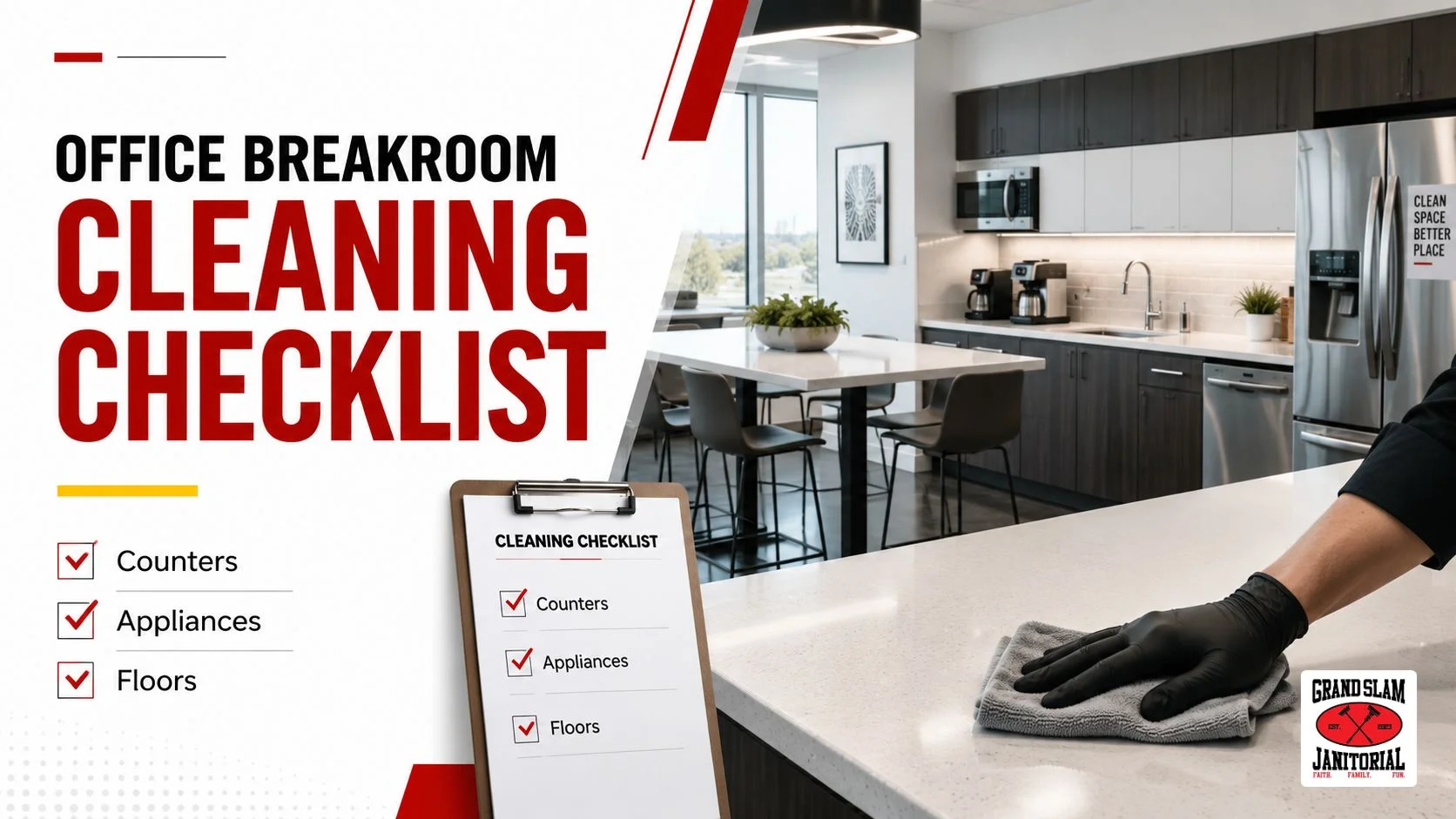
A good breakroom cleaning checklist divides the work into daily, weekly, and periodic tasks. At minimum, offices should regularly remove trash, clean food spills, wipe counters and tables, maintain sinks and appliances, clean floors, and address frequently touched surfaces such as refrigerator handles, microwave controls, faucets, and cabinet pulls.
The exact schedule should depend on how many people use the room and how it is used. A six-person office where employees mainly make coffee does not need the same office breakroom cleaning schedule as a busy workplace where dozens of people heat meals throughout the day.
The goal is not to clean everything every day. It is to clean the right things before food residue, odors, overflowing waste, sticky surfaces, and floor buildup become bigger jobs.
What Should Be Included in a Breakroom Cleaning Checklist?
A useful break room cleaning checklist should cover six basic areas:
- Counters, tables, and food-preparation surfaces
- Microwave, refrigerator, coffee station, and other shared appliances
- Sink, faucet, and surrounding splash areas
- Trash and recycling
- Floors
- Frequently touched handles, buttons, switches, and cabinet pulls
The biggest mistake is treating the breakroom like an ordinary conference room. Food, drinks, shared appliances, moisture, and waste create different cleaning needs.
Another common problem is focusing only on what employees can see. A counter may look clean while the underside of the microwave handle, refrigerator gasket, cabinet pulls, chair backs, and areas beneath appliances keep accumulating grime.
In short: A good checklist covers visible messes, food areas, shared touchpoints, appliances, waste, and floors rather than stopping at a quick wipe of the tables.
Daily Office Breakroom Cleaning Checklist
Daily work should focus on anything that becomes unsanitary, sticky, smelly, or difficult to clean when left overnight.
Counters and tables
For daily breakroom cleaning:
- Remove crumbs and visible food debris.
- Wipe counters and tables.
- Clean spills as soon as possible.
- Pay attention to table edges and frequently touched areas.
- Do not leave standing liquid around coffee or water stations.
Food-contact surfaces require extra care when cleaning products are used. Follow the product label, including any required contact time or post-cleaning rinse. EPA guidance notes that registered sanitizers and disinfectants must be used according to their label directions.
Microwave and appliance touchpoints
Microwaves can turn into one of the dirtiest-looking parts of a shared kitchen simply because spills are repeatedly reheated.
Daily office appliance cleaning should include:
- Wiping the microwave handle and controls
- Removing obvious food splatter inside the microwave
- Wiping refrigerator handles
- Cleaning coffee-machine buttons and handles
- Emptying and rinsing removable coffee pots when needed
- Cleaning obvious spills around water dispensers
Employees should be expected to clean major spills they create rather than leaving them for the next janitorial visit.
Sink and faucet
Remove food debris from the sink and wipe:
- Faucet handles
- Faucet neck
- Sink rim
- Drain area
- Counter immediately around the sink
Wet sponges and cloths should not be left indefinitely. Replace or launder reusable cleaning cloths regularly.
Trash and recycling
Trash containing food should not be allowed to sit until the container is overflowing.
Daily tasks should include:
- Emptying food waste
- Replacing liners
- Wiping visible residue from bin lids and rims
- Cleaning spills around the trash area
- Removing loose recycling
For busy breakrooms, bins may need attention more than once during the workday.
Floors
Sweep or vacuum crumbs and debris, then clean spills before they dry.
Entry areas, spaces near the sink, the coffee station, refrigerators, vending machines, and trash cans normally need the most attention.
In short: Daily cleaning should remove the mess that becomes harder, smellier, or more noticeable when it sits overnight.
Weekly Breakroom Cleaning Checklist
Daily cleaning controls the mess. Weekly breakroom cleaning catches buildup.
Set aside time each week for tasks such as:
- Cleaning the microwave interior more thoroughly
- Wiping refrigerator doors, sides, handles, and accessible gaskets
- Cleaning cabinet fronts and pulls
- Wiping backsplash areas
- Cleaning chair backs, legs, and table bases
- Washing or replacing reusable cleaning cloths
- Cleaning beneath movable countertop appliances
- Disinfecting commonly touched surfaces using the correct product directions
- Mopping the entire floor instead of only spot cleaning
- Wiping baseboards where food or drink residue collects
- Cleaning the trash container itself when needed
The refrigerator also needs a clear food-removal policy.
A simple system works better than hoping somebody eventually cleans it. Ask employees to label personal food and choose a regular refrigerator cleanout day. Communicate the policy so people know when abandoned items will be removed.
In short: Weekly cleaning is the reset. It reaches the areas that daily wiping misses without turning every cleaning visit into a full deep clean.
Monthly and Periodic Breakroom Deep Cleaning
Some work does not need to happen every day or even every week.
A periodic breakroom deep cleaning can include:
- Pulling movable appliances forward and cleaning underneath
- Cleaning accessible areas behind refrigerators or other equipment
- Washing cabinet interiors when necessary
- Detailing baseboards and corners
- Removing buildup from floor edges
- Cleaning interior glass
- Inspecting walls for food or beverage splatter
- Cleaning vents and accessible vent covers
- Shampooing carpeted areas where applicable
- Performing deeper hard-floor maintenance when the flooring requires it
Do not automatically schedule every task monthly. Frequency should reflect actual use.
A lightly used executive kitchenette may stay manageable with less frequent detailing. A high-traffic employee breakroom serving several shifts may need deeper cleaning much sooner.
That is why a fixed checklist should be treated as a starting point rather than an unchangeable rule.
How Often Should an Office Breakroom Be Cleaned?
Most breakrooms need basic cleaning every business day, deeper attention each week, and periodic detailing based on usage, spills, floor type, appliances, and employee count.
A practical schedule looks like this:
Frequency | Main Focus | Typical Tasks |
Daily | Food, waste, and visible mess | Trash, counters, tables, spills, sink, appliance handles, floor debris |
Weekly | Buildup and missed areas | Appliance interiors, cabinet fronts, full floor cleaning, chair legs, baseboards |
Periodic | Detail work | Behind appliances, vents, cabinet interiors, floor detailing, carpet or hard-floor care |
As needed | Unexpected problems | Large spills, odors, illness-related cleaning, overflowing waste |
Traffic matters more than the calendar.
Consider increasing the frequency when:
- Several departments share one breakroom.
- Employees regularly prepare full meals.
- The office operates multiple shifts.
- Trash fills before the end of the day.
- Floors repeatedly become sticky or visibly soiled.
- The refrigerator fills quickly with employee food.
- Shared appliances receive constant use.
In short: Clean according to use. A checklist should tell your team what to inspect, not force every office into the same schedule.
Cleaning, Sanitizing, and Disinfecting Are Not the Same Thing
These terms are often used interchangeably, but they refer to different jobs.
Cleaning removes dirt, crumbs, grease, spills, and other material from a surface.
Sanitizing reduces microorganisms on a surface to the level specified for the product and its intended use.
Disinfecting uses a product designed to kill or inactivate specified microorganisms on surfaces when used according to its label.
This distinction matters in a breakroom because not every surface needs the same treatment.
A sticky table needs to be cleaned first. A frequently touched non-food-contact handle may sometimes call for high-touch surface cleaning followed by an appropriate disinfectant. A food-contact counter requires products and procedures suitable for that use.
Never assume that spraying more product works better. EPA guidance says registered products should be used according to their label, including application method and contact time.
Who Should Clean the Office Breakroom?
Employees should handle the immediate messes they create, while assigned staff or a cleaning company should manage scheduled cleaning, trash removal, floor care, sanitization, and deeper work.
Expecting employees to do all janitorial work usually creates an accountability problem.
At the same time, cleaners should not be expected to solve avoidable employee behavior such as abandoned dishes, open food containers, or major spills left untouched all afternoon.
A clearer division looks like this:
Employees | Office/Janitorial Team |
Wipe up personal spills immediately | Clean counters and tables on schedule |
Put trash in the correct bin | Remove trash and replace liners |
Wash or store personal dishes | Clean sinks and shared touchpoints |
Label personal food | Perform scheduled refrigerator cleanouts |
Remove personal clutter | Sweep, mop, vacuum, and maintain floors |
Report appliance leaks or problems | Perform scheduled breakroom sanitization |
Clean major food splatter they create | Handle periodic breakroom deep cleaning |
Post the employee rules somewhere visible, but keep them short.
Nobody is reading a 30-point sign while making coffee.
How Do You Keep an Office Breakroom Clean Between Janitorial Visits?
The easiest way to support a professional office cleaning checklist is to prevent small messes from becoming cleaning projects.
Use a few simple rules:
Clean spills immediately
Coffee left on a counter for six hours takes more work to remove than coffee wiped up in 20 seconds.
Give everything a place
Provide clear locations for:
- Trash
- Recycling
- Clean dishes
- Used dishes
- Paper towels
- Cleaning supplies
- Shared condiments
Clutter usually gets worse when employees do not know where something belongs.
Create a refrigerator policy
Pick a cleanout day and tell employees how unlabeled or abandoned food will be handled.
Keep supplies stocked
Employees cannot wipe spills when there are no paper towels or appropriate cleaning supplies available.
Make problems easy to report
A leaking refrigerator, clogged sink, broken trash lid, or damaged floor should not sit unnoticed for weeks.
In short: Professional cleaning works better when the office has simple rules for the hours between cleaning visits.
When Does a Breakroom Need Professional Cleaning?
A small office may be able to manage some routine cleaning internally. That does not mean staff should automatically be responsible for every cleaning task.
Professional commercial office cleaning becomes more practical when:
- Employees are repeatedly missing scheduled tasks.
- The office needs cleaning several days per week.
- Trash and floors require regular service.
- Restrooms and breakrooms are being cleaned under the same facility schedule.
- Managers are spending work time chasing cleaning responsibilities.
- Floors need periodic buffing, carpet cleaning, or strip-and-wax work.
- The business wants one defined cleaning scope instead of informal employee rotation.
- Multiple office areas need recurring attention.
A recurring office cleaning plan can also prevent the familiar situation where everyone assumes somebody else cleaned the microwave, emptied the trash, or mopped the floor.
Grand Slam Janitorial provides commercial cleaning in Las Vegas and commercial cleaning in Flagstaff, including office and breakroom cleaning as part of customized cleaning plans. A walkthrough helps determine which tasks need daily attention, which can be scheduled less often, and which specialty services should stay separate from routine janitorial work.
A Practical Checklist Office Managers Can Use
Here is a simplified version you can adapt for your workplace.
Daily
- Remove food-related trash
- Replace trash liners
- Wipe tables
- Clean counters
- Clean visible spills
- Wipe microwave controls and handle
- Wipe refrigerator handle
- Clean sink and faucet
- Sweep or vacuum floor debris
- Spot mop spills
- Check soap and paper supplies
Weekly
- Clean microwave interior
- Clean refrigerator exterior and accessible gasket
- Remove abandoned or expired food according to office policy
- Clean coffee station thoroughly
- Wipe cabinets and handles
- Clean chairs and table bases
- Mop the full floor
- Clean trash-bin surfaces
- Wipe baseboards and reachable ledges
Periodic
- Clean beneath movable appliances
- Detail corners and floor edges
- Clean cabinet interiors
- Clean accessible vents
- Clean interior glass
- Inspect walls for splashes or stains
- Schedule carpet or hard-floor maintenance when needed
- Review whether cleaning frequency still matches office usage
Keep the checklist somewhere the person responsible for cleaning can actually use it. A form buried inside an employee handbook is not much help during a cleaning visit.
Frequently Asked Questions
A breakroom cleaning checklist should cover tables, counters, food-contact areas, sinks, faucets, appliances, trash, recycling, floors, high-touch surfaces, cabinets, and periodic detail work. Divide those tasks by frequency so cleaners know what needs daily attention and what can wait.
Daily office breakroom cleaning should focus on food spills, counters, tables, sinks, appliance handles, trash, recycling, and floor debris. High-use offices may need some of these areas cleaned more than once per day.
Clean visible refrigerator spills when they happen and establish a regular food-removal schedule. Exterior handles usually need much more frequent attention than interior shelves because employees touch them throughout the day.
Use a written office breakroom cleaning checklist, assign responsibilities, require employees to clean immediate personal messes, keep cleaning supplies stocked, establish a refrigerator policy, and schedule recurring professional cleaning when internal upkeep is no longer reliable.
Employees should clean spills, dishes, food, and clutter they personally create. Routine janitorial services, floor cleaning, trash removal, scheduled sanitization, and deeper cleaning should have a clearly assigned owner rather than depending on whoever happens to notice the mess.
Not every surface automatically requires daily disinfection. Cleaning frequency and product choice should depend on the surface, usage, workplace conditions, and product instructions. When a disinfectant is used, follow its label, including contact-time and surface-use directions.
Consider professional cleaning when the breakroom is heavily used, internal cleaning keeps getting skipped, the business already needs recurring office or restroom cleaning, or floors and other surfaces require equipment and periodic specialty care.
Keep Your Breakroom Routine Simple Enough to Follow
The most effective breakroom cleaning checklist is not the longest one. It is the one that clearly separates daily mess control, weekly cleaning, periodic detailing, and employee responsibilities.
Start with the areas people use most: tables, counters, appliances, sinks, trash, and floors. Then adjust the schedule based on your actual workplace rather than following a generic calendar.
If keeping the breakroom clean is becoming another job for your office manager, Grand Slam Janitorial can build it into a recurring cleaning plan along with the rest of your facility. Businesses looking for office cleaning in Las Vegas, janitorial services in Las Vegas, office cleaning in Flagstaff, or janitorial services in Flagstaff can schedule a free walkthrough to discuss the space, cleaning frequency, and service needs.
Call Grand Slam Janitorial or request a free walkthrough to build a cleaning plan around your workplace.
