
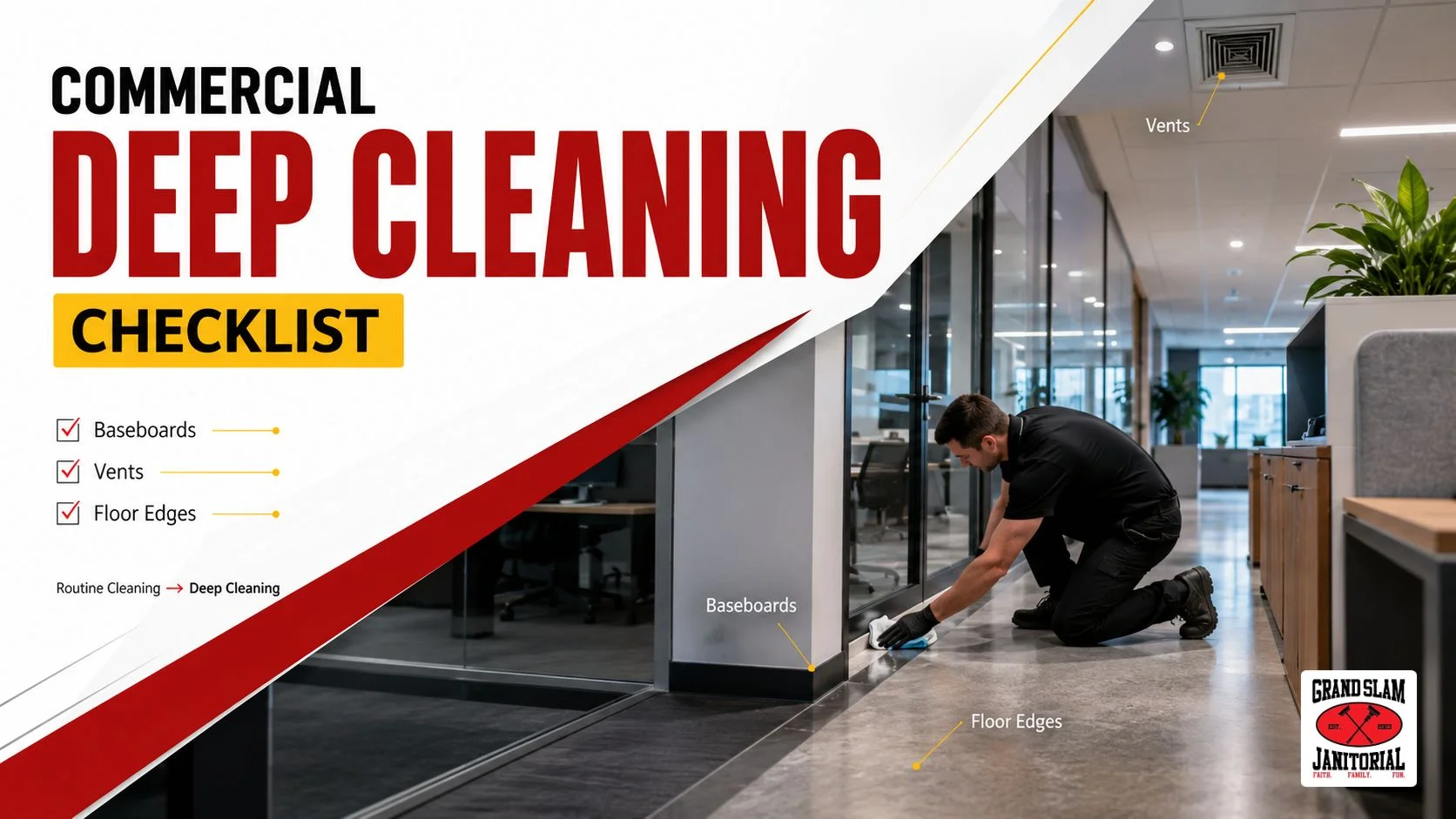
A commercial deep cleaning checklist should cover the areas routine janitorial cleaning does not fully address: edges and corners, walls, vents, high surfaces, detailed restroom cleaning, buildup around fixtures, spaces behind movable furniture, and periodic floor, carpet, and window care when needed.
The exact checklist should not be identical for every property. An office with 15 employees, a busy retail location, and a multi-tenant commercial facility will have different traffic patterns, surfaces, sanitation needs, and problem areas.
The practical goal is simple: use routine cleaning to maintain the building and scheduled deep cleaning to deal with buildup and neglected areas before they become bigger cleaning problems.
How to Use This Commercial Deep Cleaning Checklist
Before assigning individual tasks, decide what the deep clean is supposed to accomplish.
Are you resetting a facility after months of routine maintenance? Preparing for a move-in? Dealing with visible buildup? Adding periodic cleaning to an ongoing janitorial program?
Start with a walkthrough of the property and identify:
- High-traffic areas
- Restrooms and breakrooms
- Hard-to-reach surfaces
- Floor types
- Carpeted areas
- Interior glass
- Frequently touched shared surfaces
- Areas hidden behind or underneath movable furniture
- Stains, buildup, dust, or neglected corners
- Any areas that require specialty equipment
Then separate the work into routine cleaning, deep cleaning, and specialty cleaning.
That distinction matters because an office deep cleaning checklist should not simply repeat tasks already being completed every night.
In short: Deep cleaning should target accumulated dirt and areas outside the normal maintenance scope, not just add more repetitions of routine cleaning tasks.
Start With the Areas Routine Cleaning Often Misses
A good facility cleaning checklist begins at the edges rather than the obvious center of the room.
Floors may already be vacuumed or mopped regularly. Trash may already be removed. Restrooms may already receive daily service.
Deep cleaning goes further.
High and hard-to-reach areas
Include:
- Upper ledges
- Tops of cabinets
- High shelving
- Accessible light fixtures
- Vent covers
- Door frames
- Partition tops
- Corners near ceilings
- Other accessible elevated surfaces where dust has accumulated
High dusting is easy to postpone because these areas usually fall outside the normal line of sight. That is exactly why they should be part of a periodic deep-cleaning plan.
Edges, corners, and baseboards
Check:
- Floor edges
- Corners behind doors
- Baseboards
- Wall-to-floor transitions
- Areas around furniture legs
- Behind movable chairs and small furnishings
Routine mopping and vacuuming can maintain the open areas of a room while leaving gradual buildup around its perimeter.
Walls and vertical surfaces
Look for:
- Fingerprints
- Scuff marks
- Splash marks
- Dust near vents
- Buildup around switches and door frames
Not every wall needs to be washed from top to bottom every time. Spot cleaning may be enough in some facilities, while heavily used areas may need more detailed work.
In short: If a surface is above eye level, behind something, along an edge, or outside the normal cleaning path, inspect it during a deep clean.
Room-by-Room Commercial Deep Cleaning Checklist
Breaking the building into zones makes the work easier to scope and verify.
Reception and lobby
Reception areas receive visitors, deliveries, employees, and customers, so they can show wear quickly.
Deep-clean tasks may include:
- Detail-cleaning entry doors and interior glass
- Wiping door frames and trim
- Cleaning accessible ledges and decorative surfaces
- Vacuuming upholstered visitor seating where appropriate
- Cleaning underneath movable furniture
- Detail-cleaning floor edges and corners
- Wiping baseboards
- Removing marks from washable surfaces
- Cleaning accessible vents
- Sanitizing frequently touched contact points where required
Routine commercial office cleaning should already handle obvious trash, visible surfaces, and regular floor cleaning. The deep clean should focus on the areas normal service does not reach thoroughly.
Private offices and workstations
Employees often have personal items, paperwork, electronics, and sensitive materials around their desks.
Before cleaning, establish what cleaners are permitted to move or touch.
Tasks may include:
- Detailed dusting of accessible surfaces
- Cleaning tops of partitions
- Cleaning chair bases and legs
- Wiping accessible cabinet exteriors
- Cleaning baseboards
- Vacuuming floor edges
- Cleaning under movable chairs or small furniture
- Spot-cleaning washable walls
- Cleaning accessible vents
- Sanitizing approved shared touchpoints
Do not assume cleaners should move paperwork, computers, confidential documents, or employees’ personal belongings. Scope those rules before service begins.
Conference and meeting rooms
Include:
- Table edges and bases
- Chair backs, arms, legs, and bases
- Whiteboard ledges
- Accessible AV equipment surfaces
- Interior glass partitions
- Door frames
- Baseboards
- Floor edges
- Accessible vents
- Frequently touched shared surfaces
Conference rooms often look clean at first glance because the main table gets wiped regularly. A deep clean should look underneath, around, and above the obvious surfaces.
Breakrooms and kitchens
A useful breakroom cleaning checklist should distinguish between appliance exteriors and interiors.
Possible tasks include:
- Cleaning countertops and backsplashes
- Detailing sinks and faucets
- Wiping cabinet fronts and handles
- Cleaning table and chair bases
- Cleaning microwave interiors when included
- Cleaning refrigerator exterior surfaces
- Cleaning underneath movable small appliances
- Detail-cleaning waste containers
- Wiping wall splashes
- Cleaning floor edges and corners
- Sanitizing shared handles and touchpoints
Never assume refrigerator contents, employee food, or cabinet contents can be discarded or moved. Establish those rules beforehand.
Restrooms
Restroom deep cleaning should go beyond wiping the same fixtures serviced during routine janitorial visits.
Inspect and clean:
- Toilets and urinals
- Sinks and faucets
- Counters
- Mirrors
- Partition walls and doors
- Dispenser exteriors
- Door handles
- Accessible vents
- Walls around fixtures
- Baseboards and edges
- Floor corners
- Areas behind and around toilets
- Waste and sanitary receptacles
Pay attention to buildup around fixture bases, partition hardware, corners, and other places a quick maintenance clean can miss.
In short: A room-by-room checklist prevents visually clean central areas from hiding buildup around edges, fixtures, furniture, and less-accessible surfaces.
Floors, Carpets, and Windows Need Their Own Plan
Some cleaning jobs should not be treated as another line item on the general checklist.
They require different equipment, processes, scheduling, or drying time.
Hard-floor care
Daily sweeping and mopping are maintenance tasks. Periodic commercial floor care may involve:
- Machine scrubbing
- Buffing or polishing
- Removing accumulated finish
- Floor stripping and waxing where appropriate for the flooring system
Floor type matters. A process suitable for one surface may be inappropriate for another, so identify the floor material before selecting a treatment.
Carpeted areas
Routine vacuuming removes loose surface debris. Periodic carpet cleaning goes deeper.
A professional carpet service may address:
- Embedded soil
- Spots and stains
- Heavily traveled pathways
- Carpeted meeting rooms
- Reception seating areas
- Areas beneath movable furnishings
Frequency should be based on actual traffic, visible condition, building use, and manufacturer or maintenance requirements rather than an arbitrary calendar date.
Windows and interior glass
Deep cleaning may include:
- Interior windows
- Glass doors
- Glass partitions
- Sills
- Tracks
- Frames
Exterior or elevated window cleaning should be scoped separately where special access or equipment is required.
In short: Floors, carpets, and windows often require specialty cleaning rather than simply “more” routine cleaning.
High-Touch Cleaning and Disinfection Are Not the Same Task
Cleaning and disinfecting should not be treated as interchangeable terms.
Cleaning removes dirt and residue from a surface. Disinfection uses an appropriate disinfectant according to its label directions to address microorganisms on suitable surfaces.
An effective high-touch surface sanitization or disinfection scope might identify:
- Door handles
- Push plates
- Light switches
- Shared phones
- Conference-room controls
- Appliance handles
- Faucet handles
- Elevator controls
- Shared counters
- Other frequently handled surfaces
More chemical is not automatically better.
The appropriate product, compatible surface, required contact time, and manufacturer instructions matter. Facilities with specialized requirements should follow their applicable workplace, industry, and infection-control procedures rather than relying on a generic office checklist.
Regular Cleaning vs. Deep Cleaning
The difference between regular cleaning and deep cleaning is mainly scope and detail.
Area | Routine Cleaning | Deep Cleaning |
Floors | Sweep, vacuum, or mop | Detail edges; machine or specialty floor care when needed |
Carpets | Routine vacuuming | Periodic extraction or shampooing where appropriate |
Restrooms | Clean fixtures, empty trash, restock | Detail partitions, edges, walls, fixture bases, vents |
Offices | Trash, accessible surfaces, routine floors | Partitions, baseboards, high surfaces, hidden areas |
Breakrooms | Counters, sinks, trash, floors | Appliance detailing, cabinet fronts, wall splashes, edges |
Glass | Spot-clean fingerprints | Detailed interior glass, frames, sills, tracks |
Dusting | Accessible horizontal surfaces | High ledges, vent covers, partition tops, hard-to-reach areas |
Regular cleaning keeps the building under control.
Deep cleaning periodically resets the areas where soil, dust, residue, and wear gradually accumulate.
One does not replace the other.
A business that skips routine cleaning and schedules an occasional deep clean will still struggle with day-to-day appearance. A business that only performs routine cleaning may eventually develop buildup in areas outside the normal service route.
In short: Routine janitorial service maintains cleanliness. Deep cleaning addresses detail and buildup. Most commercial properties benefit from using the two together rather than choosing between them.
How Often Should Commercial Offices Be Deep Cleaned?
There is no responsible one-size-fits-all answer to how often commercial offices should be deep cleaned.
Frequency should be determined by the property itself.
Consider:
- Number of employees and visitors
- Daily foot traffic
- Type of business
- Number and usage of restrooms
- Breakroom usage
- Floor and carpet materials
- Operating hours
- Seasonal or event-related demands
- Existing janitorial frequency
- Visible buildup between scheduled services
A lightly used professional office may not need the same deep-cleaning schedule as a busy retail property or multi-tenant building.
Some components may also need different schedules. Restroom detailing might be required more frequently than carpet shampooing. High dusting may be periodic while entry-floor maintenance requires closer attention.
Instead of asking, “How often should we deep clean the entire building?” ask, “Which areas are deteriorating between routine visits, and how often does each one need additional attention?”
That produces a more useful cleaning program.
Customize the Checklist to Your Facility
Generic checklists are starting points, not contracts.
A small accounting office and a warehouse should not receive identical scopes.
Offices and professional firms
Prioritize:
- Workstations
- Conference rooms
- Restrooms
- Breakrooms
- Interior glass
- Carpets
- High-touch shared surfaces
Medical offices
Cleaning plans may need stricter facility-specific procedures, product requirements, or infection-control protocols.
A standard office checklist should never be used as a substitute for applicable healthcare cleaning requirements.
Retail businesses
Focus on:
- Entrances
- Customer-facing floors
- Checkout areas
- Glass
- Restrooms
- Frequently touched surfaces
- Back-of-house areas
Warehouses and industrial facilities
Dust loads, large floor areas, equipment, storage patterns, and operational restrictions can substantially change the scope.
Multi-tenant commercial buildings
Separate shared areas from tenant spaces.
Lobbies, corridors, restrooms, elevators, entrances, and shared break areas may need different schedules from individual suites.
Businesses searching for commercial deep cleaning in Las Vegas or commercial cleaning in Flagstaff, AZ should therefore expect a provider to inspect the actual facility before recommending a scope.
A checklist copied from another building cannot account for your traffic, surfaces, floor materials, layout, or operating schedule.
What Should Be Agreed on Before a Deep Clean?
The checklist alone is not enough.
Before work starts, make sure the cleaning proposal defines:
- Areas included
- Areas excluded
- Cleaning tasks
- Specialty services
- Service frequency
- Products or restrictions
- Furniture-moving expectations
- Access requirements
- Security procedures
- Service times
- Who supplies consumables
- Who approves additional work
This is especially useful when comparing commercial janitorial services.
Two proposals can have similar prices but very different scopes. One may include vents, baseboards, breakroom appliance interiors, or periodic floor work while another does not.
Compare the task list, not just the phrase “deep cleaning.”
Grand Slam Janitorial provides customized commercial cleaning plans based on the facility rather than treating every property the same. Businesses can begin with a free on-site walkthrough and receive a detailed proposal based on their cleaning needs, service frequency, and requested specialty work.
Frequently Asked Questions
What is included in commercial deep cleaning depends on the facility, but it commonly goes beyond routine dusting, trash removal, vacuuming, and mopping.
A deep-clean scope may include detailed edges and corners, baseboards, wall cleaning, high dusting, accessible vents, deeper restroom cleaning, interior glass, areas behind movable furnishings, and specialty floor or carpet services when requested.
The answer to what areas should be cleaned daily in an office depends on traffic and usage.
Trash, restrooms, breakrooms, entrances, shared areas, high-traffic floors, and frequently touched surfaces generally deserve the closest routine attention. Lower-use areas may require a different frequency.
To determine how to create a commercial cleaning schedule, list every building area first, then identify the tasks required in each area.
Classify each task as routine, periodic deep cleaning, or specialty cleaning. Assign frequency based on traffic, building use, surface type, and how quickly the area becomes visibly soiled.
Whether an office needs professional deep cleaning depends on its condition and the work required.
Basic detailing may sometimes be handled internally. Larger facilities, specialized floor care, carpet cleaning, high-access work, or buildings requiring consistent documented service may be better suited to a professional commercial cleaning company.
Usually not.
Deep cleaning addresses accumulated buildup and overlooked areas. Regular cleaning handles the day-to-day work required to keep restrooms, floors, trash, work areas, and shared spaces maintained between deeper services.
No.
These are specialty services and should be scheduled according to flooring material, condition, traffic, maintenance requirements, and actual need. Automatically performing every specialty service during every deep clean can be unnecessary.
No.
Facility type, floor materials, traffic, operating hours, number of occupants, sanitation requirements, and current maintenance program all affect the correct scope.
Build a Deep-Cleaning Plan Around the Facility, Not a Template
The most useful commercial deep cleaning checklist is not the longest one. It is the one that clearly identifies what routine service already covers, which areas are being missed, what requires periodic attention, and which specialty services genuinely make sense for the property.
Start with the building itself.
Inspect the restrooms, breakrooms, floors, carpets, glass, high surfaces, edges, corners, vents, shared touchpoints, and areas behind movable furnishings. Then assign each task a realistic frequency instead of scheduling every service at the same interval.
Grand Slam Janitorial provides customized deep cleaning services for offices and commercial facilities in Las Vegas, Nevada, and Flagstaff, Arizona, along with recurring cleaning and specialty floor, carpet, and window services.
If your facility needs more than routine surface cleaning, schedule a free walkthrough with Grand Slam Janitorial. The team can evaluate your space, identify the areas that need attention, and prepare a cleaning proposal based on your actual facility instead of a generic checklist.
Call now, request a free quote, or schedule your commercial cleaning walkthrough.
