
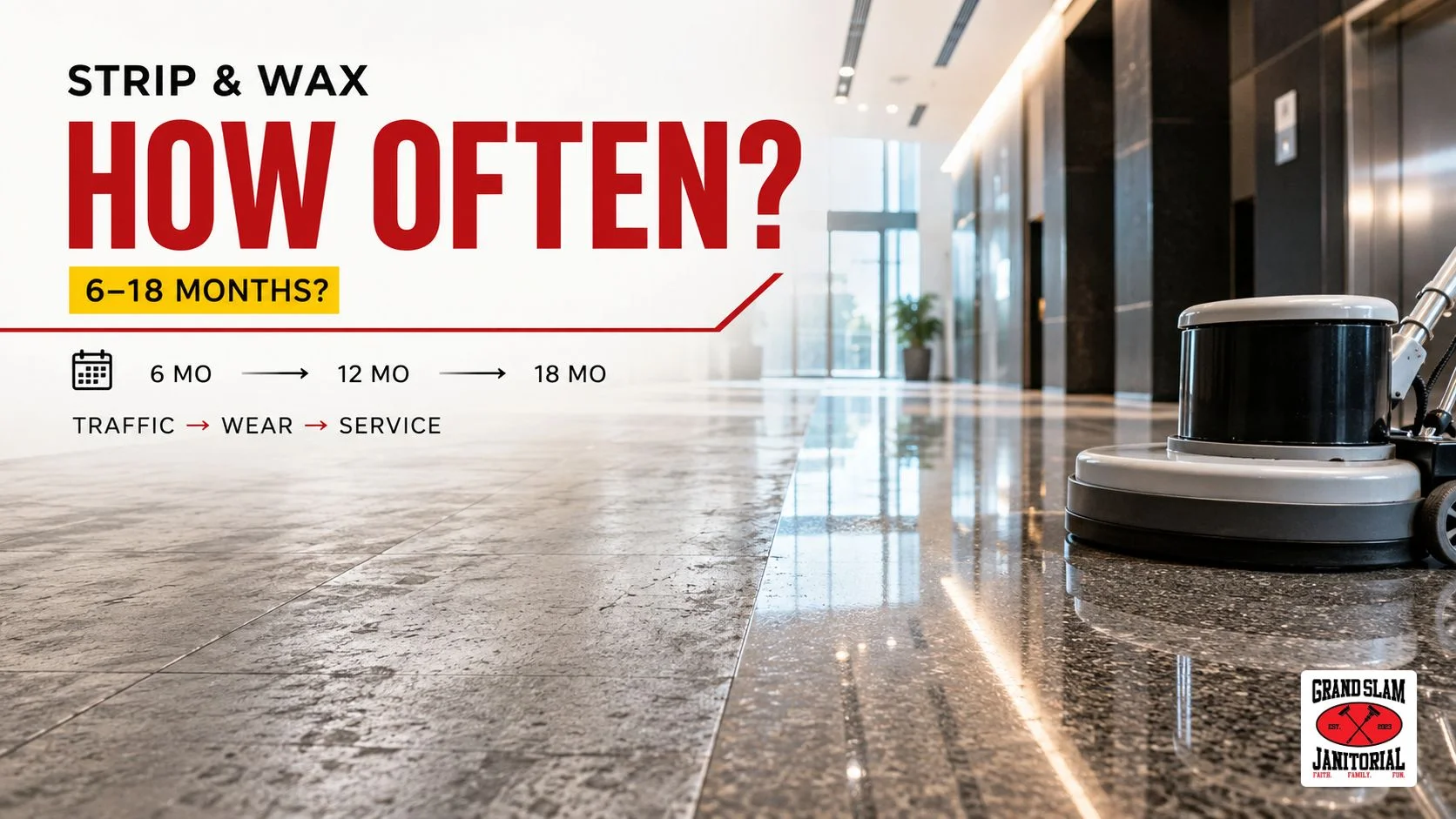
Most commercial floors that use a maintainable floor finish should be evaluated for stripping and waxing about every 6 to 18 months, but there is no single schedule that works for every building. How often commercial floors should be stripped and waxed depends mainly on foot traffic, flooring material, existing finish condition, routine cleaning, and how much dirt and moisture enter the facility.
A quiet professional office may go a year or longer between complete stripping services. A busy lobby, medical office, retail space, or heavily traveled corridor may show enough finish wear to need attention much sooner.
The better question is not simply, “Has it been 12 months?” It is, “Is the existing finish still protecting the floor, and can routine maintenance restore it?”
How Often Should Commercial Floors Be Stripped and Waxed?
A practical starting point for a strip and wax schedule is:
Floor Use | Typical Planning Range | What to Watch |
Light traffic | 12–18 months | Dullness, finish wear near entrances |
Moderate traffic | 9–12 months | Traffic lanes, scuffs, uneven gloss |
High traffic | 6–9 months | Heavy wear, exposed finish, discoloration |
Extremely demanding areas | Evaluate more frequently | Rapid finish loss, embedded soil, repeated scuffing |
These are planning ranges, not deadlines. Published commercial floor-care guidance varies because facilities experience very different levels of wear, and VCT-specific guidance commonly recommends adjusting service around traffic and maintenance rather than relying only on the calendar.
It is also normal for different areas in the same building to need different schedules. A lobby can look worn months before a conference room on the same floor.
In short: Use the calendar to trigger an inspection, not an automatic strip-and-wax job.
What Does Commercial Floor Stripping and Waxing Actually Do?
Commercial floor stripping and waxing removes deteriorated layers of old floor finish, embedded soil, and buildup before a fresh protective finish is applied.
“Wax” is the term many building owners use, although modern commercial flooring systems often use a manufactured floor finish rather than traditional wax.
A typical service involves:
- Removing loose soil and preparing the area.
- Applying the appropriate stripping product.
- Loosening and removing old finish.
- Rinsing or neutralizing the flooring as required.
- Allowing the surface to dry.
- Applying fresh coats of compatible floor finish.
The goal is not simply a shinier floor. The fresh finish creates a sacrificial layer that receives everyday scuffs and wear before that abuse reaches the underlying flooring.
That distinction matters. If the finish is still healthy, completely stripping it off may be unnecessary.
In short: Stripping is a restoration step. It should not replace good routine floor finish maintenance.
Commercial Floor Stripping and Waxing Schedule by Traffic Level
Traffic is usually the biggest driver of floor waxing frequency.
Light-traffic offices
Private offices, conference rooms, administrative areas, and other spaces with limited daily traffic often retain their finish much longer.
With consistent sweeping, damp mopping, and appropriate floor buffing, these spaces may stay in acceptable condition for 12 months or longer.
Moderate-traffic commercial spaces
Shared offices, professional buildings, medical offices, common areas, and multi-tenant facilities usually experience more predictable finish wear.
A 9- to 12-month evaluation cycle is a reasonable starting point.
High-traffic commercial floors
Entrances, checkout areas, hallways, reception areas, breakrooms, and other high-traffic commercial floors take considerably more abuse.
These spaces may need restoration closer to the 6- to 9-month range, particularly when routine maintenance can no longer restore an even appearance.
Do not assume the entire building needs to be stripped because one entrance looks bad. Dividing a facility into traffic zones can prevent unnecessary work.
Expert tip: Track the date of each service and photograph several high-traffic areas afterward. Compare those same locations every few months. That gives facility managers a much better maintenance history than relying on memory.
What Makes a Commercial Floor Need Service Sooner?
Several factors can shorten the normal commercial floor maintenance cycle.
Foot traffic
Every shoe, cart, delivery, and rolling chair adds wear. Buildings with hundreds of daily visitors will usually break down a finish faster than a quiet office.
Dirt and grit
Small particles tracked indoors can act like abrasives under foot traffic.
This is particularly relevant around Las Vegas entrances, where dry soil and grit can be carried into commercial spaces. Effective entry mats and regular dust removal can help reduce that wear.
Moisture and winter debris
Flagstaff facilities can face a different entrance problem. Moisture and debris carried indoors during winter can place extra stress on heavily traveled entry areas.
The solution is not automatically more stripping. Better matting and more frequent entrance maintenance may extend the existing finish.
Cleaning practices
Using unsuitable chemicals, allowing dirty solution to remain on the floor, or letting abrasive soil accumulate can shorten finish life.
Good VCT floor maintenance generally involves regular dry-soil removal and cleaning products appropriate for the finish being maintained.
Building use
A private accounting office and a busy medical reception area should not share an identical maintenance schedule simply because their flooring looks similar.
Spills, rolling equipment, concentrated foot traffic, and operating hours all change the amount of wear.
Existing floor condition
Older finish with scratches, embedded soil, discoloration, or multiple uneven layers may reach the end of its useful life sooner than recently refinished flooring.
In short: Traffic tells you how quickly to inspect. Floor condition tells you what service is actually needed.
How Do You Know When a Floor Needs Stripping and Waxing?
A date on a maintenance spreadsheet is useful, but the floor itself gives better information.
Watch for these signs:
- Finish remains dull after normal cleaning.
- Buffing no longer restores an even appearance.
- Heavy traffic lanes remain visible.
- The finish looks yellow, cloudy, or uneven.
- Scuffs and scratches are becoming difficult to remove.
- Soil appears trapped beneath older finish layers.
- Certain areas appear worn while protected corners remain glossy.
- Repeated recoating has created visible wax buildup.
Dullness by itself does not always mean the floor needs to be stripped.
A dirty floor may need deeper cleaning. A mildly worn finish may respond to buffing. A finish with enough remaining material may be suitable for a scrub-and-recoat process.
A full strip becomes more reasonable when the existing finish is too damaged, contaminated, uneven, or built up to restore effectively.
That distinction can save businesses from paying for aggressive restoration work sooner than necessary.
Do You Need a Full Strip and Wax Every Time?
No.
One of the biggest mistakes in commercial floor care is treating every loss of shine as a stripping problem.
There are three different levels of maintenance worth separating.
Service | Best Used When | What It Does |
Routine cleaning and floor buffing | Finish is intact but losing gloss | Cleans and improves surface appearance |
Scrub and recoat | Finish is worn but still serviceable | Removes surface soil and adds fresh finish |
Full strip and wax | Existing finish is heavily deteriorated or built up | Removes old finish and rebuilds the protective layer |
Regular burnishing, cleaning, and periodic recoating can delay the need for complete stripping when the existing finish remains serviceable.
This is why an inspection matters. Automatically stripping a floor every few months can create unnecessary labor, chemical use, and downtime.
In short: Use the least aggressive maintenance method that will properly restore and protect the floor.
What Types of Floors Can Be Stripped and Waxed?
Not every hard floor belongs on a floor stripping services schedule.
VCT floor maintenance commonly includes floor finish, buffing, recoating, and eventual stripping. Certain other resilient flooring systems may also be compatible with finish-based maintenance.
Other materials require completely different care.
Hardwood, laminate, ceramic tile, natural stone, polished concrete, and manufacturer-specific resilient floors should not automatically be treated like VCT.
Industry guidance also warns against assuming that every floor material should receive the same strip-and-wax process.
Before using a stripper or finish, identify:
- The flooring material
- The existing coating or finish
- Manufacturer maintenance instructions
- Previous products applied to the floor
- Current surface condition
When those details are unknown, inspection comes before chemical application.
How to Build a Floor Care Plan for Las Vegas and Flagstaff Facilities
A good commercial floor care plan should connect daily cleaning with periodic restoration.
Start with five steps.
1. Identify the floor material
Know which surfaces actually use a maintainable finish.
2. Divide the building by traffic level
Separate entrances, corridors, reception areas, private offices, storage areas, and other zones.
There is no reason to treat all of them as if they receive identical wear.
3. Improve routine soil control
Regular sweeping or dust mopping removes abrasive particles before they repeatedly travel across the finish.
Entrance matting also matters because preventing soil from entering is easier than removing it after it becomes embedded.
4. Inspect instead of guessing
Look at gloss, traffic patterns, scratches, buildup, and whether routine cleaning still produces acceptable results.
5. Choose the correct maintenance level
Use routine cleaning and floor buffing while the finish remains healthy. Consider recoating when surface protection is wearing down. Reserve full stripping for a finish that can no longer be restored effectively.
Grand Slam Janitorial provides floor strip-and-wax, floor buffing, and commercial cleaning services for businesses in Las Vegas and Flagstaff. The company offers customized cleaning plans, flexible service options, and free on-site walkthroughs rather than forcing every facility into one standard schedule.
Its current service pages also describe plans based on flooring type, traffic level, and business scheduling needs.
In short: The most efficient plan combines routine cleaning, preventive maintenance, periodic inspections, and restoration only when the floor actually needs it.
Keep the Floor on the Right Schedule, Not Just a Fixed Schedule
So, how often should commercial floors be stripped and waxed? For many facilities, evaluating the floor somewhere within a 6- to 18-month window makes sense, with high-traffic areas checked sooner. The actual decision should come from floor type, traffic, finish condition, and whether less aggressive maintenance can still restore the surface.
If the floor still responds to cleaning or buffing, a complete strip may be premature. If the finish is badly worn, uneven, contaminated, or buried under old buildup, delaying restoration can make the job harder.
Grand Slam Janitorial can inspect your commercial flooring and recommend an appropriate combination of routine cleaning, buffing, recoating, or full strip-and-wax service for your facility in Las Vegas or Flagstaff.
Schedule a free on-site walkthrough or request a quote to build a floor-maintenance plan around your actual flooring, traffic, and business schedule.
Frequently Asked Questions
A common planning range is approximately 6 to 12 months, but traffic and maintenance can move that schedule in either direction. High-use entrances may need attention earlier, while lightly used office areas may last longer.
Sometimes. If the existing finish is still sound, a professional may be able to clean or scrub the floor and apply a maintenance coat instead of removing every existing layer.
Continually adding finish without proper preparation, however, can eventually create buildup.
Look for persistent dullness, uneven traffic lanes, discoloration, embedded dirt, scratches that no longer respond to buffing, or old finish that has become difficult to restore.
Yes. Appropriate floor buffing can restore gloss and maintain an existing finish, which may extend the time between complete strip-and-wax services.
It cannot repair a finish that has already failed or remove heavy layers of contaminated buildup.
Foot traffic, flooring material, entrance soil, moisture, cleaning products, maintenance frequency, rolling equipment, spills, and the existing finish condition all play a role.
Not necessarily.
A heavily traveled lobby may require restoration while private offices remain in good condition. Maintaining floors by traffic zone can reduce unnecessary work and business disruption.
VCT is one of the most common examples. Some other resilient floor systems may accept commercial finish as well, but flooring and finish manufacturer instructions should always be checked before choosing a strip-and-wax process.
