
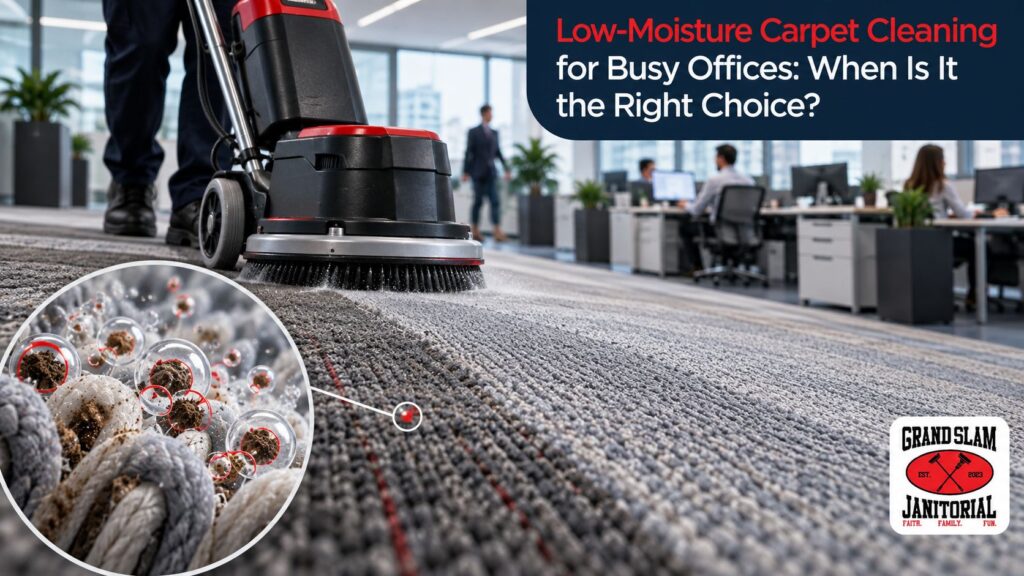
Low-moisture carpet cleaning for offices is a practical choice when carpets need routine maintenance, the soil level is moderate, and the workspace must return to normal use without a long drying period. It is particularly useful for suitable carpet tiles, corridors, meeting rooms, and traffic lanes that receive regular professional care.
It is not automatically the right choice for heavily contaminated carpet, serious odor problems, flood-related damage, or situations requiring extensive rinsing. The carpet type, soil condition, previous treatments, ventilation, and manufacturer’s instructions should determine the method.
In short: Choose low-moisture cleaning when controlled moisture and limited disruption matter. Choose a more restorative method when the carpet needs deeper soil removal or rinsing.
What is low-moisture carpet cleaning?
It is a category of carpet-cleaning methods that use less liquid than traditional restorative extraction.
The term can describe several processes, including:
- Encapsulation
- Compound cleaning
- Bonnet or pad cleaning
- Controlled-moisture agitation
- Other very-low-moisture systems
These methods are not completely dry. “Low moisture” means the process controls the amount of liquid applied so the carpet does not become heavily saturated.
The exact procedure depends on the carpet, cleaning product, machine, pad or brush system, and type of soil.
In short: Low-moisture cleaning is controlled-moisture maintenance, not water-free cleaning.
How does encapsulation carpet cleaning work?
Encapsulation carpet cleaning is one of the most common low-moisture methods used in commercial spaces.
A simplified process may include:
- Inspecting the carpet and identifying its construction
- Testing for color, texture, or chemical concerns
- Thoroughly vacuuming loose soil
- Treating appropriate spots
- Applying an encapsulating cleaning product
- Agitating the carpet using compatible equipment
- Allowing the carpet and cleaning product to dry
- Vacuuming the area again according to the product instructions
During drying, the specialized cleaning chemistry surrounds or “encapsulates” loosened soil and dries into a brittle residue. Subsequent vacuuming removes the dried material from the carpet.
Pre-vacuuming is not an optional shortcut. Removing as much dry soil as possible before applying moisture improves the efficiency of the later cleaning steps. Industry training and manufacturer guidance treat dry-soil removal as a core part of commercial carpet maintenance.
In short: Encapsulation loosens and surrounds soil so it can be removed through vacuuming after the carpet dries.
When is low-moisture carpet cleaning right for an office?
Consider it when the carpet is suitable, the facility is active, and the goal is periodic appearance maintenance rather than correction of severe contamination.
The office cannot tolerate extended downtime.
Call centers, professional offices, medical administrative areas, retail offices, and multi-tenant properties may not be able to close large areas for an extended period.
Low-moisture work can often be completed in sections. Employees can be redirected while each zone is cleaned and allowed to dry.
The carpet receives regular maintenance.
This method works more effectively when the carpet is vacuumed properly and cleaned before traffic lanes become severely soiled.
Waiting until every walkway is dark, sticky, or heavily matted reduces the chance that a lighter maintenance method will produce a satisfactory result.
Carpet tiles are installed.
Carpet tile cleaning often needs careful moisture control because the flooring includes seams, backing, and adhesive. Some commercial carpet-tile manufacturers include encapsulation within their approved maintenance options, but the exact product instructions still control.
Only selected zones need attention.
Traffic lanes, reception areas, corridors, copy rooms, and entrances may become dirty before private offices or low-use rooms.
Targeted high-traffic carpet cleaning can maintain these zones without cleaning every carpeted area at the same frequency.
The office needs an interim maintenance service.
Low-moisture cleaning can sit between routine vacuuming and periodic restorative cleaning. It helps the facility respond to visible traffic wear before the entire carpet requires a more intensive service.
In short: Low-moisture cleaning fits maintained carpets, moderate soil, active facilities, suitable carpet tiles, and high-traffic zones that need quicker turnaround.
When is another method more appropriate?
Low-moisture cleaning has real limitations. A contractor should not recommend it simply because it is convenient to schedule.
Heavy or deeply embedded soil
Carpet that has gone too long without professional care may require more extensive rinsing and soil recovery.
Widespread oily residue
Oil can bind soil to carpet fibers. Offices connected to workshops, warehouses, kitchens, or industrial environments may need a different combination of chemistry, agitation, and extraction.
Serious odors or below-surface contamination
Odor may come from the carpet surface, backing, cushion, adhesive, subfloor, or repeated spills. Cleaning the visible fibers does not guarantee that a below-surface source has been corrected.
Flood or sewage exposure
This is not an ordinary carpet-cleaning problem. Water-damaged or contaminated carpet requires proper restoration assessment, extraction, drying, and potentially disposal.
The Carpet and Rug Institute recommends professional water extraction and drying procedures for soaked carpet, with disposal considered when mud, sewage, or other serious contaminants are present.
Carpet that needs extensive rinsing
Hot water extraction applies a cleaning solution and removes suspended soil through an extraction process. It may be more appropriate when the carpet requires restorative cleaning rather than interim appearance maintenance.
Permanent wear or fiber damage
Cleaning cannot rebuild crushed fibers, repair damaged carpet tiles, reverse permanent dye loss, or restore a worn pattern. A dark traffic lane may be soil, physical wear, or both.
Can low-moisture cleaning remove deep stains? Some marks may improve, but no responsible contractor should promise complete removal before identifying the substance, carpet fiber, age of the stain, and previous treatments.
In short: Choose another approach when the problem involves heavy contamination, deep rinsing, water damage, below-surface odor, or physical carpet damage.
Low-moisture cleaning vs hot water extraction
“Steam cleaning” usually refers to hot water extraction, even though steam itself is not the main cleaning mechanism.
Factor | Low-moisture cleaning | Hot water extraction |
Main role | Interim or appearance maintenance | Periodic restorative cleaning |
Moisture level | Lower | Higher |
Typical drying requirement | Generally shorter | Generally longer |
Good fit for | Moderate soil and active office environments | Heavier soil and carpets requiring deeper rinsing |
Operational disruption | Often easier to manage in sections | May require more time and access control |
Soil recovery | Depends on the low-moisture process and later vacuuming | Soil and solution are recovered through extraction |
Suitable for every carpet? | No | No |
Manufacturer approval needed? | Yes | Yes |
Replaces vacuuming? | No | No |
Corrects permanent wear? | No | No |
Is low-moisture cleaning better than steam cleaning?
No method is universally better.
Low-moisture cleaning may be the better operational choice for regularly maintained office carpet with moderate soil. Extraction may be the better cleaning choice when the carpet needs rinsing or restorative work, and the building can support the required drying conditions.
Some commercial carpet-maintenance instructions alternate encapsulation with periodic extraction rather than relying indefinitely on one method. Follow the manufacturer’s plan for the installed carpet.
How long does low-moisture carpet take to dry?
It generally dries faster than a wetter extraction process, but no single drying time applies to every office.
Actual carpet drying time depends on:
- Amount of moisture applied
- Carpet fiber and construction
- Carpet backing
- Indoor humidity
- Room temperature
- Air circulation
- HVAC operation
- Soil level
- Cleaning chemistry
- Furniture placement
- Size of the treated area
A contractor should inspect these conditions before promising when employees can walk on the carpet or when furniture can be returned.
“Quick drying” also does not mean immediately ready. Premature traffic can track soil onto damp fibers, interfere with the cleaning process, or create marks around furniture.
Ask the contractor to state:
- Expected drying range
- When light foot traffic can resume
- When furniture can be replaced
- Whether air movers are needed
- What ventilation should remain operating
- Whether a post-cleaning vacuum visit is required
In short: Low-moisture cleaning usually reduces drying time, but ventilation, carpet construction, and the exact process still determine when the space can reopen.
How busy offices can reduce cleaning disruption
The method matters, but the service plan matters just as much.
Divide the office into zones
Separate the facility into:
- Entrances and reception areas
- Main walkways
- Workstations
- Conference rooms
- Private offices
- Breakroom approaches
- Copy and equipment rooms
- Low-traffic areas
High-traffic zones can receive more frequent attention without cleaning the full office every time.
Schedule work outside peak hours
Evening, weekend, or phased service gives the carpet time to dry without employees walking through the area.
Move only what is necessary.
Determine whether employees need to clear personal items, floor mats, rolling chairs, small furniture, or electrical cords before the crew arrives.
Communicate reopening times
Mark treated zones and tell employees when they can return. Do not depend on people noticing that carpet is still damp.
Coordinate with routine janitorial work.
Vacuuming, entry-mat maintenance, and prompt spot treatment should support periodic commercial carpet cleaning. Carpet should not be ignored between machine-cleaning appointments.
How to build a commercial carpet maintenance program
A carpet maintenance program should respond to traffic and soil patterns rather than treating every carpeted room the same.
Routine maintenance
- Vacuum entrances and traffic lanes frequently
- Use effective entry matting
- Clean or replace saturated mats
- Address spills promptly
- Record recurring spot locations
- Keep food and drink policies practical
Interim maintenance
- Inspect traffic lanes for visible change
- Use an approved low-moisture method where appropriate
- Clean high-use zones separately
- Review whether spots are returning after treatment
Restorative cleaning
- Schedule extraction or another manufacturer-approved method when interim work is no longer sufficient
- Allow adequate drying
- Inspect carpet backing, seams, and tile adhesion
- Replace damaged tiles when cleaning cannot correct the problem
The IICRC’s carpet-cleaning standard focuses on evaluating carpet type, characteristics, condition, appearance retention, and soil-removal needs before establishing the procedure.
That is the right logic for commercial carpet care: diagnose first, choose the process second.
Questions to ask before approving low-moisture cleaning
Before hiring a contractor, ask:
- What carpet fiber and construction do we have?
- Does the manufacturer approve the proposed method?
- Is this an interim or restorative cleaning?
- What low-moisture system will be used?
- Is pre-vacuuming included?
- How are spots tested and treated?
- What results are realistic for the current condition?
- Will a post-cleaning vacuum be required?
- What is the expected drying range?
- How will treated areas be isolated?
- When can furniture and rolling equipment return?
- When would you recommend extraction instead?
- Are the products and equipment appropriate for this carpet?
- Is the cleaning plan documented by area and frequency?
Avoid a provider who recommends a method without inspecting the carpet or asking about previous cleaning, spill history, and operational requirements.
Carpet cleaning in Las Vegas and Flagstaff offices
Businesses seeking office carpet cleaning Las Vegas should pay close attention to entryways, main walkways, reception areas, and zones where outdoor grit is tracked inside.
A commercial carpet cleaning Las Vegas plan may combine frequent vacuuming, entrance-mat care, spot treatment, and periodic machine cleaning based on visible traffic patterns.
For office carpet cleaning Flagstaff, seasonal moisture, tracked-in debris, and winter entrance conditions can create different demands near doors and primary walkways.
A commercial carpet cleaning Flagstaff program should separate these entrance zones from protected offices that may not require the same frequency.
The city alone does not determine the method. The installed carpet, traffic, ventilation, contamination, and drying requirements matter more.
Frequently Asked Questions
No. Most low-moisture systems use some liquid. The difference is that the amount is controlled and generally lower than with traditional extraction.
Sometimes the work can be completed in sections while other parts of the facility remain open. The treated zone should remain restricted until the contractor says it is ready for use.
No. Thorough vacuuming is necessary before cleaning, and some encapsulation systems require additional vacuuming after the product dries.
It may improve some surface-level odor issues, but it will not necessarily reach contamination in the backing, cushion, adhesive, or subfloor.
It can be suitable for many commercial carpet-tile systems. The carpet manufacturer’s maintenance instructions and adhesive limitations should be checked first.
Frequency depends on traffic, carpet color, entry conditions, vacuuming quality, spills, and appearance expectations. High-traffic zones may need interim cleaning more often than private offices.
It may be. Some carpet manufacturers recommend periodic extraction within a program that also uses interim low-moisture cleaning. Follow the instructions for the installed carpet rather than adopting a universal schedule.
Choose the method after assessing the carpet.
Low-moisture carpet cleaning for offices is most useful when a suitable carpet needs routine maintenance, and the business cannot accept a long drying period. It can help maintain traffic lanes and active workspaces, but it should not be marketed as a replacement for every other cleaning method.
Heavily soiled carpet, serious odors, water damage, extensive residue, or below-surface contamination may require extraction, restoration work, or replacement. The honest recommendation begins with inspecting the carpet and understanding what the office needs.
Grand Slam Janitorial currently advertises commercial carpet shampooing, spot treatment, flexible scheduling, and customized carpet-cleaning proposals for businesses in Las Vegas and Flagstaff. Its public service pages do not specifically identify low-moisture encapsulation, so businesses should confirm the available method during the walkthrough.
Schedule a free walkthrough with Grand Slam Janitorial to assess your office carpet, identify high-traffic problem areas, and receive a cleaning plan based on its construction, condition, and operational needs.
